K3 hasn’t officially launched yet. It might not need to.
On the evening of July 15, Moonshot AI dropped a 36-second video simultaneously across Bilibili and X. No product manager, no whitepaper, no voiceover — just the number “3” flashing for less than half a second. Everyone in the industry understood immediately.
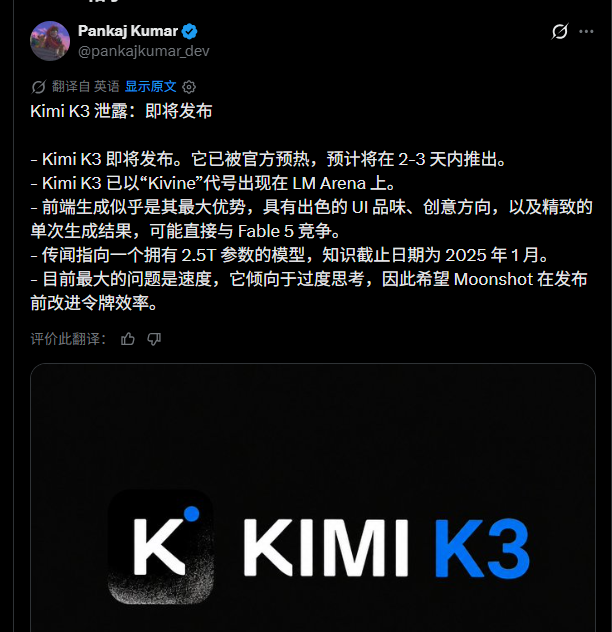
At the exact same time, something called Kivine was climbing the Chatbot Arena ranks in anonymous mode. Nobody knew who built it. They just knew it could code, model, and — incredibly — generate full interactive 3D pages in a single pass.
You already know where this is going.

Question 1: Why now?
Moonshot picked a fascinating launch window.
A month ago, Anthropic published its own cross-benchmark evaluation. Alongside Claude Opus 4.8 and GPT-5.5 sat one outlier: Kimi K2.7 — the only non-American model on the list. This wasn’t some third-party ranking. This was Anthropic’s internal assessment telling the world “this Chinese model belongs in the conversation.”
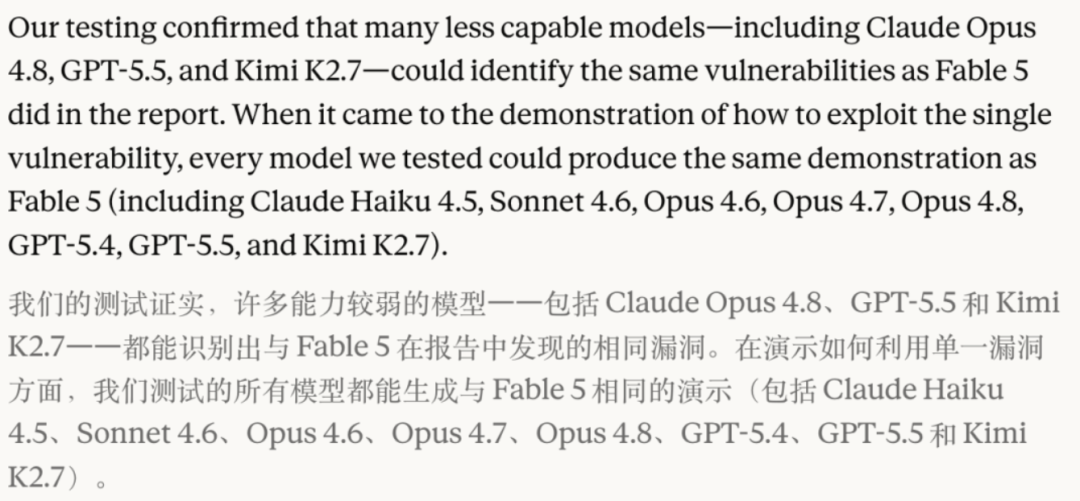
The timing is deliberate. K2.7 just got its international validation, and K3 is landing right on cue. But here’s what’s interesting: Moonshot skipped a number. From K2 to K2.6 to K2.7 Code, they’d been doing monthly incremental bumps. K3 isn’t K2.8.
In the LLM world, you don’t skip numbers unless you’ve changed the architecture.
Question 2: How much bigger is it?
Let’s skip the spec sheet and talk about one number: 2.5 trillion parameters.
For context: DeepSeek-V3 runs 671 billion total with 37 billion active per inference, and that was already enough to match GPT-4 on most benchmarks. K3 nearly quadruples the total parameter count. MoE architecture means it’s not just “bigger” — it’s “smarter about being big.” Expert networks activate selectively based on the task, so you’re not burning compute on irrelevant capacity.
But raw scale isn’t what makes K3 feel like a generational leap. Two other things do.
Question 3: What does a million tokens actually unlock?
This number gets thrown around so often it’s lost meaning. Let me reframe it.
Take the entire Linux kernel source tree — 12 million lines of C, roughly 700,000 tokens with comments and docs. K3 can swallow it whole and still have 300,000 tokens of headroom.
Or this: the complete Three-Body Problem trilogy clocks in around 900,000 tokens. You can feed it the entire series and ask “who first proposed the dark forest hypothesis — Zhang Beihai or Luo Ji?” Without RAG. Without chunking. Without losing context mid-chapter.
That’s not “long context.” That’s “context without boundaries.” The gap between those two phrases is the gap between a chatbot and something closer to AGI.
Question 4: Is Agent Swarm real or just hype?
In the K2.6 era, Agent Swarm already posted numbers that feel borderline absurd: 300 sub-agents deployed simultaneously, over 4,000 tool calls in a single task, 4.5x speedup over sequential single-agent execution.
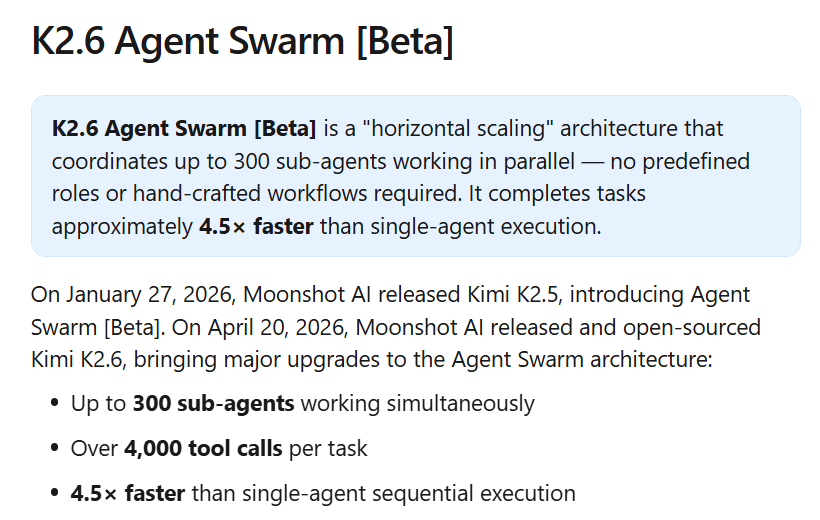
The natural question: doesn’t it get chaotic with that many agents?
The answer is what separates Agent Swarm from traditional parallelization. Old approach: write a script, split work into N chunks, dispatch to N workers, merge results. Agent Swarm: the model itself decides how to decompose, assign, and orchestrate. Task decomposition and role assignment happen as real-time inference decisions, not pre-programmed rules.
K3 reportedly hardens this at the systems level — not just more agents, but higher closed-loop success rates. And that’s the metric that actually matters for real-world deployment. An agent that finishes 9 out of 10 tasks versus 6 out of 10 is the difference between “cool demo” and “I’d pay for this.”
Question 5: What’s the actual developer verdict on Kivine?
This is where it gets fun.
K3’s Chatbot Arena alias is Kivine. Arena works on blind voting — you see two anonymous model outputs, you pick the better one, then the names are revealed. Kivine climbed the ranks purely on output quality, with zero brand recognition to coast on.
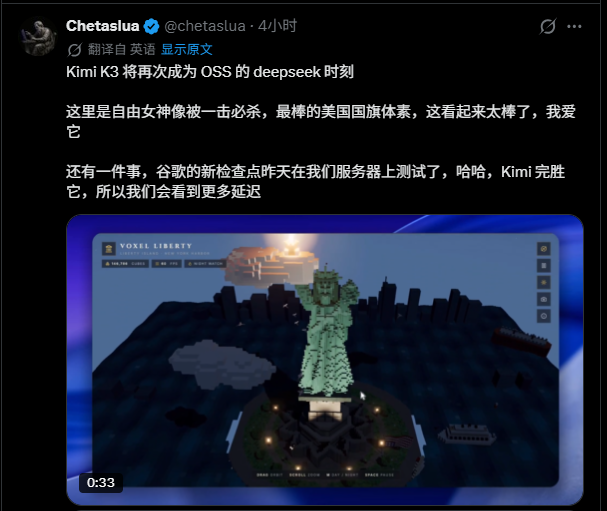
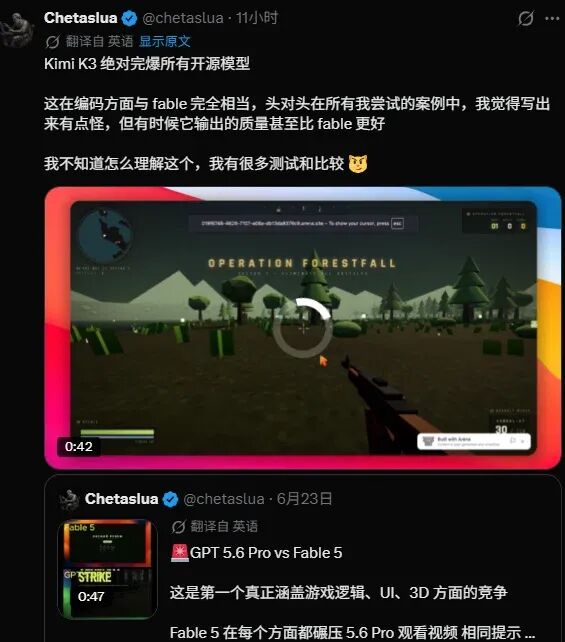
@chetaslua — a developer known for punishing models with borderline-impossible tasks — threw voxel modeling at Kivine. Not “draw a cube,” but full 3D scene generation. One shot, one result. Then pure-code video cloning: take a video effect, replicate it entirely in HTML/CSS/JS with zero external assets. Same thing. Clean pass.

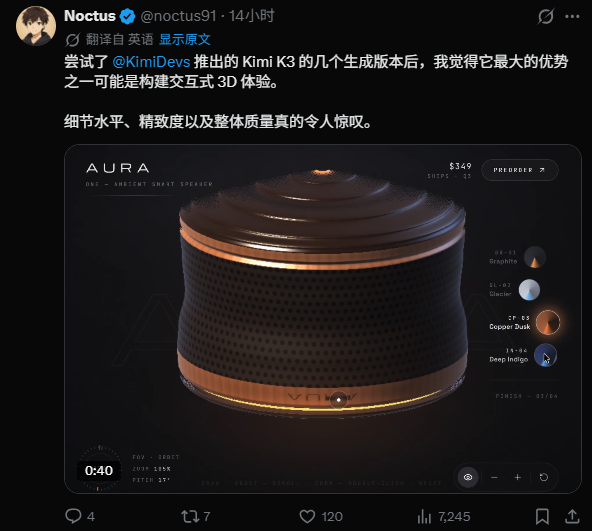
@noctus went for something more practical: a 3D smart speaker product showcase page. Lighting, materials, animations — all running natively in the browser via Three.js. In the frontend world, this is what you’d call a “production-grade demo.” A model generating this end-to-end in a single response means its understanding of Three.js is structural, not stochastic.
The nickname “Chinese Fable 5” has started circulating. It’s said half in jest, but here’s the thing — when the joke reference is Fable 5, you’ve already been admitted to the conversation.
Question 6: Who actually wins against Fable 5?
Nobody. And that’s precisely what makes this interesting.
@testingcatalog ran the cleanest comparison: identical Universe Simulation task, both models, side by side. Fable 5 is the steady veteran — fast response, stable components, no surprises. K3 is the ambitious rookie — bolder visual design, more complex animations, occasionally makes you wait a few extra seconds.

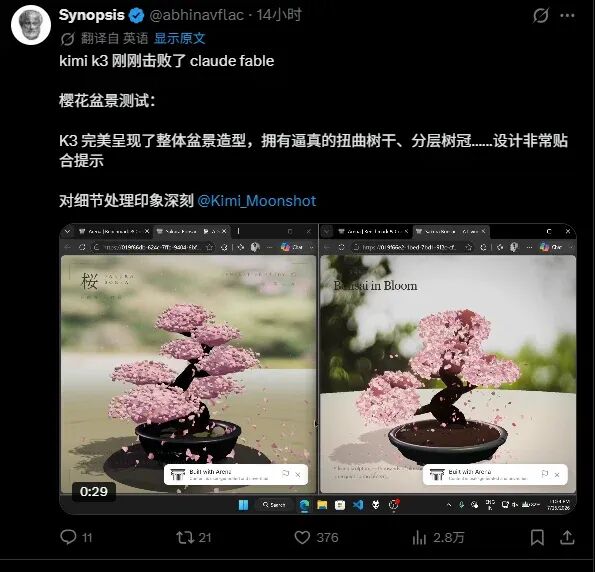
@abhinavflac tested with a cherry blossom bonsai generation and found K3 actually outworked Fable 5 on detail — bark texture, petal density, light layering. You can see the extra compute being spent on refinement.
@TokenGremlin gave what I think is the fairest assessment: “K3’s overall web design capability is approaching Fable 5 — a genuine breakthrough for a Chinese model.” The second half is the key. He’s not comparing K3 to other Chinese models. He’s using Fable 5 as the measuring stick.

But let’s be honest about the weakness: K3 is slow. Not functionally slow — cognitively slow. Multiple developers flagged the same issue: longer thinking times, noticeable wait for output. In a world where Fable 5 is approaching near-instant response, this latency gap is real and it matters.
Question 7: What happens next?
Here’s something I suspect most people haven’t registered yet.
For two years, the dominant narrative in Chinese AI has been “catching up” — catching up on parameters, catching up on benchmarks, catching up on leaderboard positions. K3 chose a different axis entirely. It didn’t chase GPT on math or Claude on safety. It went straight for agent orchestration and frontend generation — and it did it with the model’s native capabilities, not by wrapping external toolchains.
That changes the competitive dimension.
Before: Chinese models vs. American models on a single racetrack. Now: multi-axis distributed competition. Your benchmark scores might beat mine, but my agent coordination is better. You might edge me on certain tasks, but my closed-loop success rate is higher.
This isn’t a zero-sum fight. The rules of the entire game are being rewritten.
Of course, all of this comes with the caveat that K3 hasn’t officially launched. Kivine is an anonymous test version. Inference speed, API pricing, final architecture — none of that is public yet. But based on what the developer community has already surfaced, we’re well past “Chinese models are improving.” We’re at “Chinese models are defining their own battlefields.”
In that 36-second teaser, the number “3” flashed for under half a second. But if you connect the dots of Chinese AI over the past two years — from chasing to running alongside, from chatbots to agents, from benchmark scores to actual usability — that half-second might carry more weight than most people realize.