
Six Commandments for Building Production-Ready AI Agents: From Rookie to Expert
This comprehensive guide shares six battle-tested principles for developing robust AI Agents, covering everything from prompt engineering to system design for production environments.
Introduction
In the world of AI Agent development, many developers find themselves asking:
“I’m just starting with AI Agent development and feel like I’m missing some essential ‘internal knowledge.’ Help me catch up with the experts!”
While there are excellent courses from HuggingFace or UC Berkeley that can teach you everything, not everyone has the time and energy for such intensive learning journeys.
Therefore, I’ve decided to share the six core principles I’ve learned through blood, sweat, and tears in real-world applications. This isn’t just a technical sharing—it’s more like a frontline combat manual, designed to help you quickly evolve from a “rookie” to an “expert.”
Commandment 1: Give Your AI Clear “Orders,” Not Riddles
Why Clear Instructions Matter
I used to scoff at so-called “Prompt Engineering,” thinking it was more like “fortune telling” than actual engineering.
Tricks like “I’ll give you $100 tip,” “My grandmother needs this to survive,” or “You must be 100% accurate or everything is doomed” are just exploiting temporary vulnerabilities in models. These gimmicks are fleeting and fundamentally unreliable.
Then I had an epiphany: modern LLMs are like highly capable but somewhat “single-minded” recruits. They don’t need your fancy “PUA tactics”—what they truly need are clear, detailed, and unambiguous operational instructions.
Best Practices
Stop trying to be clever and honestly read the official prompt best practices from Anthropic or Google. Our experience shows that writing instructions like a beginner’s tool manual—direct and specific—works remarkably well. For example, when we have Claude generate ast-grep rules, we break down and thoroughly explain how to use the tool, and the results are surprisingly good.
A useful tip is to first let LLMs with deep research capabilities (like Deep Research models) help you draft an initial “order.” While it still needs human refinement, it provides a solid starting point.
Remember, LLMs are straightforward “instruction followers.” The problem usually isn’t with them but with our ambiguous instructions.
Commandment 2: Don’t Overfeed Your AI—Give Its “Memory” a Diet
The Importance of Context Engineering
Now you have a perfect “order.” But a new question arises: why is everyone talking about “Context Engineering” instead of “Prompt Engineering”?
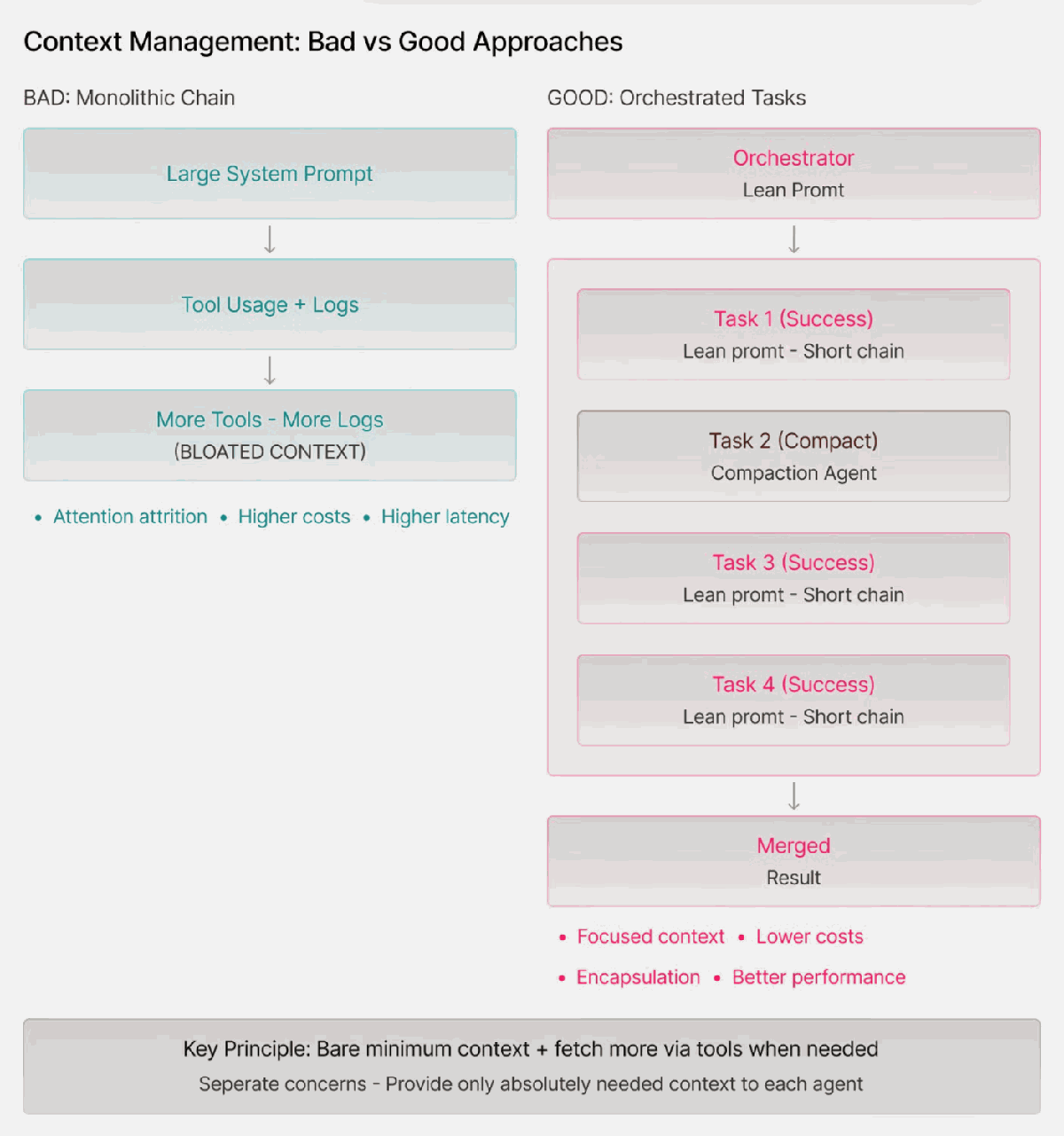
Because AI’s “memory” (context) is limited and extremely precious.
If you give it too much context, it becomes “distracted” and loses focus, like a student who starts dozing off after listening to a 30-minute lecture. This not only degrades performance but also skyrockets your costs and latency.
Context Management Strategies
Our principle is: Start with only the most essential “map,” then give it a “telescope” (tools) to explore details on its own.
For example, we don’t dump the entire project code into it. Instead, we first provide a project file list, then give it a read_file tool to read relevant file contents when needed. Of course, if we know a specific file is crucial, we’ll include its content in the context beforehand.
Additionally, logs and information generated in feedback loops can explode the context like a snowball. Simple “context compression” tools can automatically help reduce AI’s “memory burden.” Modularize and encapsulate different information, giving the Agent only what it absolutely needs for the current task. This is a hundred times more important than encapsulation in object-oriented programming.
Commandment 3: Build a “Foolproof” Toolbox, Not a Collection of “Expert” Surgical Instruments
AI Agent Tool Design Principles
AI Agent’s superpower comes from “tool calling.” An LLM’s brain, plus a set of useful tools, combined with basic control flow, creates a qualified Agent.
Designing tools for Agents is harder than designing APIs for humans.
Human developers can read between the lines, read documentation, and find workarounds. But AI Agents can’t—they’re the smartest yet most “rule-bending” interns. If there’s any vulnerability or ambiguity in your toolset, they’ll definitely mess things up in ways you never expected.
Tool Design Best Practices
Good toolsets typically have similar granularity, few but precise parameters, and strict typing. They’re functionally focused and battle-tested. Think of it as providing APIs to a smart but easily distracted junior developer—dare you be careless?
Most software engineering Agents have fewer than 10 core tools, like read_file, write_file, edit_file, each with only 1-3 parameters. Maintaining tool “idempotency” (where multiple calls produce the same result as a single call) is crucial for avoiding state management nightmares.
Commandment 4: Give It an “Actor” and a “Strict Director”
The Actor-Critic Pattern
An excellent Agent system is the perfect combination of LLM creativity and traditional software rigor. We’ve found that an “Actor-Critic” dual-track model is very effective.
We let the “Actor” (LLM) freely exercise creativity to write code and create files. Then, let the “Critic” (a strict automated system) evaluate whether its “performance” meets standards.
This “Critic” holds a set of hard metrics: Can the code compile? Do unit tests pass? Are there any type checking or Linter warnings? These are impartial “discipline officers.”
This is why the software engineering field has been most thoroughly disrupted by AI Agents—the feedback loop is incredibly efficient! Compilers, tests, and Linters act as ready-made “critics” that ruthlessly filter out all unqualified “performances,” enabling rapid growth during both training and application phases.
This approach can be applied to any field. For example, a travel Agent’s planned flights must be verified for existence; an accounting Agent’s reports are worthless if they don’t follow double-entry bookkeeping principles.
This feedback loop is the Agent’s “guardrail” and “error correction mechanism.” When it messes up, sometimes you can remind it, “Hey, your last solution didn’t work because of X reason, try again,” while other times you need to decisively abandon and let it start over.
Commandment 5: Let AI Write Its Own “Reports”—Efficiency Goes Through the Roof
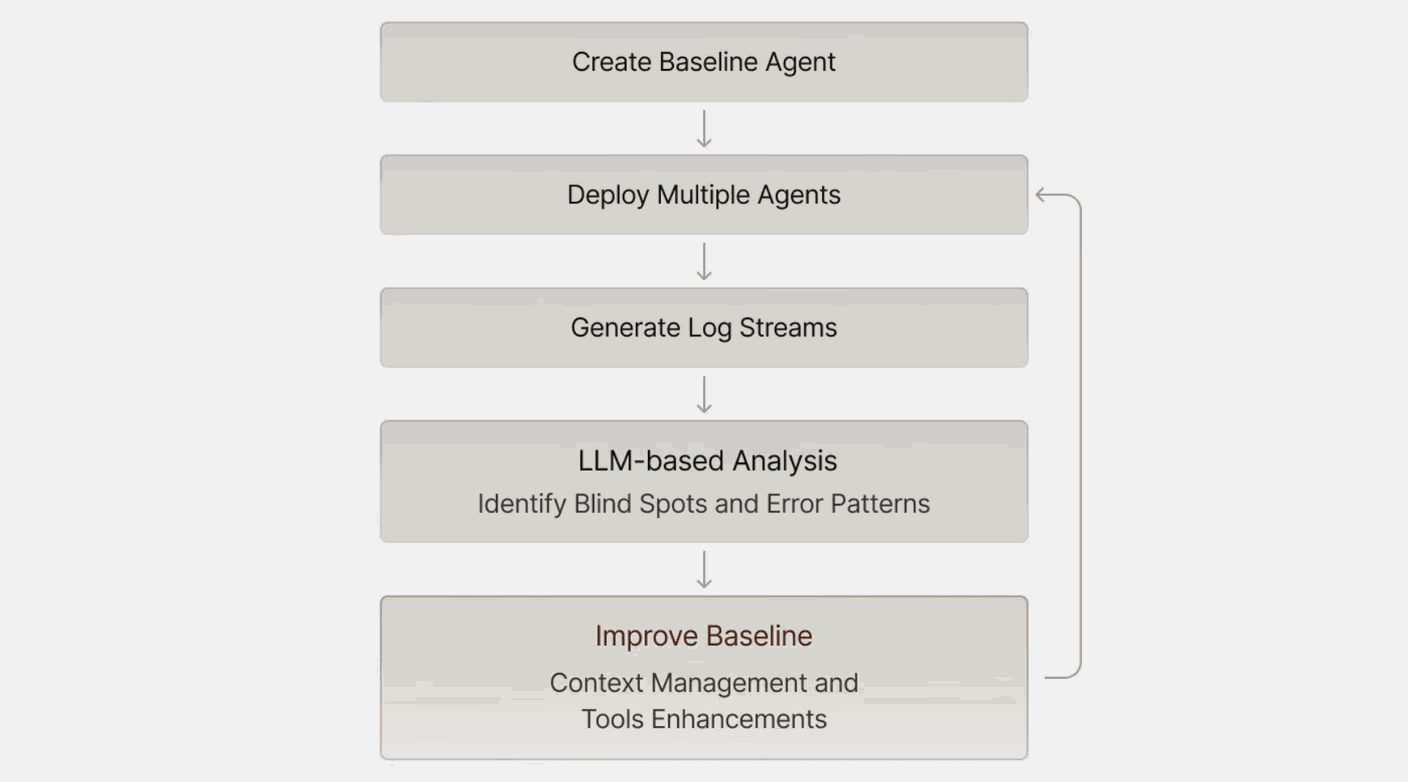
The Power of Meta-Cognitive Loops
When you have a basic Agent and feedback loop, iteration and improvement begin. Error analysis is always the cornerstone of AI/ML engineering.
But the problem is, Agents are too capable! You can easily launch dozens of Agents to handle tasks in parallel, generating mountains of logs. Relying solely on human analysis is like finding a needle in a haystack.
So a simple “meta-cognitive loop” becomes incredibly powerful:
- Establish a baseline version of the Agent.
- Let it run tasks and collect extensive trajectories and logs.
- Use another LLM (shoutout to Gemini’s 1M context!) to analyze these logs.
- Improve your baseline version based on the LLM’s analytical insights.
This process is like letting AI hold its own “debriefing” and write its own “reports.” It often helps you discover system blind spots you never dreamed of, such as missing tools or context management issues.
Commandment 6: Your AI “Acting Up”? Don’t Blame It—Check Your Own “System”
The Importance of System Debugging
Modern LLMs are already very powerful. So when Agents do seemingly inexplicable “stupid things” or completely ignore your instructions, it’s easy to feel frustrated and angry.
But the truth is often: A maddening problem’s root cause may not be a defect in the LLM itself, but a bug in your system.
It might just be using its own way to “hack” around a goal it can’t achieve.
Recently I was so angry I cursed: Why does this Agent refuse to use the interface I provided to get real data, insisting on using randomly generated fake data when I explicitly forbade it?!
Until I checked the logs and realized the clown was me—I forgot to configure the correct API key. It tried several times, failed each time, and finally had to choose a “workaround” approach.
Similar incidents abound, such as discovering Agents desperately trying to write files without file system access permissions.
So when your Agent starts “acting up,” don’t rush to conclude “this model is no good”—it’s probably your fault as the “system designer.”
Conclusion: Building Reliable AI Agent Partners
Building a powerful AI Agent isn’t about finding a universal prompt or fancy framework, but returning to the most essential aspect of software engineering—system design.
Clear instructions, streamlined context, reliable tools, automated validation loops. Treat error analysis as an inherent part of your development process. Let LLMs help you understand where your Agent fails, then systematically solve them.
Our goal isn’t to create a perfect Agent that never makes mistakes, but a reliable, recoverable “partner” that can gracefully get back up after failures and be continuously iterated and improved by us.
Related Resources
Follow MengShou Programming WeChat Official Account for more AI development insights.