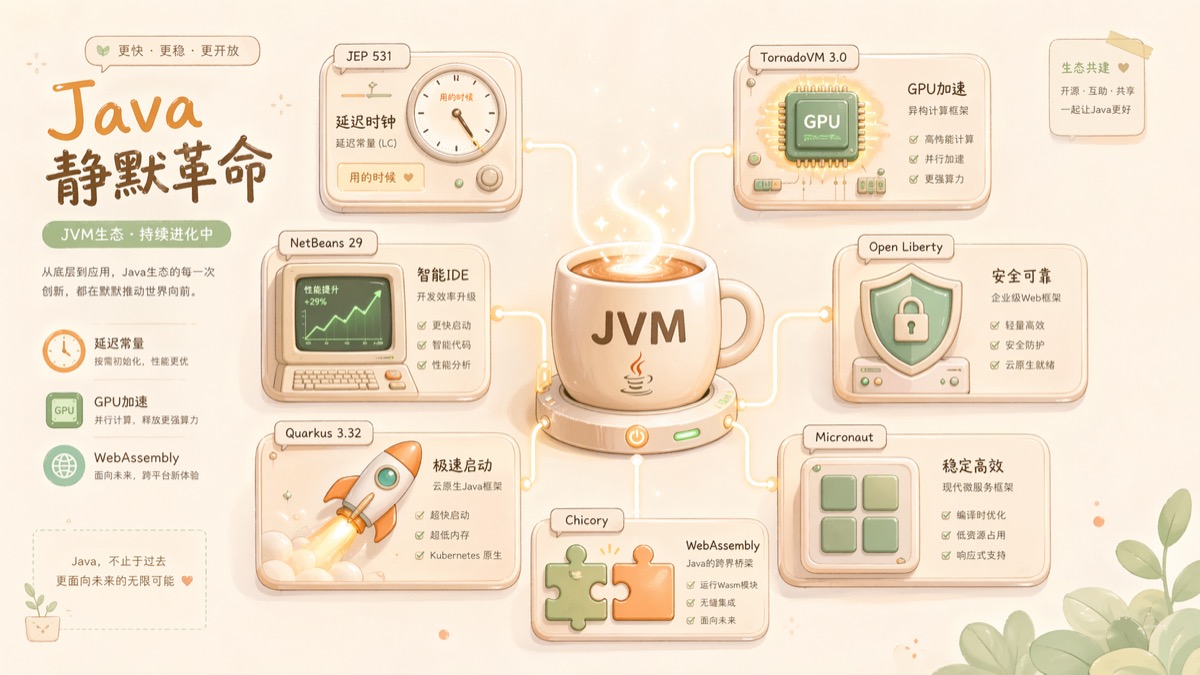
Java Isn’t the “Safe Bet” Anymore
When people think of Java, the first word that comes to mind is “stable.” How stable? Stable enough that “you can’t go wrong choosing Java” became industry consensus. For decades, while new languages grabbed headlines with flashy syntax and trendy frameworks, Java quietly ran things in the background.
But February 2026 changed that.
No big announcements, no flashy demo videos, not even front-page news. But if you looked closely at this week’s Java ecosystem updates, you’d notice something: we’re not seeing incremental patches. We’re witnessing infrastructure upgrades that fundamentally change how Java performs, handles concurrency, and interoperates.
From OpenJDK’s lazy constants to Chicory running WebAssembly on the JVM, Java is quietly building the foundation for the next decade of computing.
Lazy Constants: The Art of Saving Money
The Problem
Imagine you run a restaurant. Every morning, you prep all your ingredients whether any customers show up or not. The result? Some ingredients go bad before you use them. You paid for everything, but only used a fraction.
That’s exactly how Java’s traditional constant initialization works:
// Initialize eagerly, whether you need it or not
public static final ExpensiveObject INSTANCE = new ExpensiveObject();
This “always be prepared” strategy causes startup bloat in large applications. In microservices and containerized deployments, every millisecond counts. Your application might only use 10% of its features, but you’re paying for 100% of the initialization.
A New Approach
JEP 531 (Lazy Constants) flips the script: compute when needed, then cache forever.
// Initialize on first use, cache permanently
private static final LazyConstant<ExpensiveObject> LAZY_INSTANCE =
    LazyConstant.of(ExpensiveObject::new);

public static ExpensiveObject getInstance() {
    return LAZY_INSTANCE.get(); // Computed once, cached forever
}
Think of it like switching to a “prep when ordered” model. Once you prep an ingredient, you remember it. Next time the same dish is ordered, you skip the prep.
What’s New in This Update
JEP 531 has graduated from draft to Candidate status, now in its third preview. Two significant changes:
First, isInitialized() and orElse() methods were removed. Why? The Java architects realized these violated the core design principle. Lazy constants are about guaranteeing state exists when you need it, not about checking whether it exists.
Second, new ofLazy() factory methods let you create lazily initialized collections:
List.ofLazy(...)
Set.ofLazy(...)
Map.ofLazy(...)
These collections have a unique property: lazy before initialization, immutable after. Thread-safe, memory-efficient, scaling from zero to production without wasting heap space.
Who Benefits Most
If you’re building microservices, cloud-native applications, or anything with a large classpath, this solves the startup bloat problem. In containerized environments, deferring initialization to first request can mean the difference between hitting your SLA or missing it.
TornadoVM 3.0: Java Finally Gets GPU Power
From Research Project to Production-Ready
TornadoVM 3.0.0 hit General Availability. This isn’t just a version bump—it’s a statement: the project graduated from “interesting research” to “production-ready acceleration layer.”
Put simply, TornadoVM lets you write Java code that automatically runs in parallel on GPUs. No CUDA, no language switch.
What the Code Looks Like
TaskGraph taskGraph = new TaskGraph("saxpy")
    .transferToDevice(DataTransferMode.FIRST_EXECUTION, x, y)
    .task("t0", SAXPY::compute, alpha, x, y)
    .transferToHost(DataTransferMode.EVERY_EXECUTION, y);

ImmutableTaskGraph immutableTaskGraph = taskGraph.snapshot();
TornadoExecutionPlan executor = new TornadoExecutionPlan(immutableTaskGraph);
executor.execute();
This code automatically parallelizes on your GPU, with memory management handled by the TornadoVM runtime. Machine learning inference, financial simulations, scientific computing—the performance ceiling just got higher, and you’re still writing familiar Java.
Other Changes
The --intellijinit CLI flag was removed. Don’t panic—not a feature removal, a workflow optimization. IDE configuration is now developer-only, giving end users a cleaner CLI interface.
TornadoVM 3.0 now maintains separate release tracks for JDK 21 and JDK 25. This acknowledges a reality: enterprises on LTS releases need stability, while early adopters want the latest features. Both needs are served.
NetBeans 29: Old IDE, New Energy
In an era of VS Code dominance and IntelliJ supremacy, Apache NetBeans keeps shipping. Version 29 proves “mature” doesn’t mean “stagnant.”
The headline feature: improved project initialization performance. If you’ve ever opened a large Maven multi-module project and watched the progress bar crawl, you know this matters. NetBeans 29 defers project metadata loading until you interact with specific modules, cutting startup times on large codebases.
A smaller but noteworthy addition: Codeberg project support. As developers migrate to Forgejo-based platforms, NetBeans is ready.
Open Liberty: Security Patches and Toolchain Sanity
Open Liberty 26.0.0.2 brings two notable updates.
Java Toolchain Support
It’s here. Previously, a frustrating scenario: your code works fine, you switch to JDK 21, and builds fail. Why? Your build tool was using a different JDK than your runtime.
Now you can explicitly separate them:
- Build JDK: What Maven or Gradle uses to compile
- Runtime JDK: What Open Liberty uses to run your application
No more mysterious UnsupportedClassVersionError surprises in production.
Security Vulnerability Fix
CVE-2025-14914, a remote code execution vulnerability affecting versions 17.0.0.3 through 26.0.0.1. The attack vector? Path traversal in ZIP file uploads allowing arbitrary file overwrite.
If you’re on an affected version, upgrade now. This is the kind of vulnerability that keeps security teams up at night.
Quarkus 3.32: Faster Starts, Graceful Goodbyes
Project Leyden Integration
Quarkus 3.32 integrates with Project Leyden, Oracle’s initiative to improve Java startup time and footprint.
What does this mean for Quarkus developers?
- Pre-computed optimization data: expensive startup computations can be cached
- Faster time-to-first-request: critical for serverless and scale-to-zero scenarios
- Lower memory footprint: share more data
This isn’t just a Quarkus feature—it’s a preview of where the entire Java ecosystem is heading. When Leyden becomes standard in future JDK releases, Quarkus users already have the infrastructure to leverage it.
Graceful Shutdown
Anyone who’s deployed microservices knows this pain: Kubernetes sends SIGTERM, your pod starts shutting down, but load balancers still route traffic for those critical milliseconds. Result? HTTP 503 errors in your logs and confused users.
Quarkus 3.32 introduces more graceful shutdown that minimizes 503 responses during the shutdown process. A small change that moves the needle on production reliability metrics.
Micronaut 4.10.9: Steady and Reliable
No major version fanfare, Micronaut continues its maintenance cadence. Version 4.10.9 focuses on:
- Servlet module: bug fixes for traditional servlet container deployments
- Spring integration: better compatibility for migrations
- MCP integration: Model Context Protocol updates
This is the kind of release you deploy on a Tuesday afternoon without anxiety. No breaking changes, just accumulated fixes that make your production environment more stable.
Chicory 1.7.0: WebAssembly Meets the JVM
WebAssembly promised “write once, run anywhere,” primarily for the web. Chicory extends that promise: run WebAssembly wherever you run Java.
Version 1.7.0 brings two major specification compliances:
GC Proposal Support
WebAssembly’s Garbage Collection proposal allows modules to directly use structs and arrays without manual memory management. This means languages compiled to Wasm can keep their object models instead of being forced into linearization.
Component Model Proposal
This is WebAssembly’s module system. It enables Wasm modules to communicate through clear, language-agnostic interfaces rather than sharing memory.
Why It Matters
Chicory makes WebAssembly a first-class citizen in the Java ecosystem. You can safely run Wasm modules compiled from other languages on the JVM, enjoy sandbox isolation, and keep Java’s toolchain and workflows.
This isn’t “Java is being replaced”—it’s “Java is becoming more open.” Interoperability is becoming a first-class concern.
The Bottom Line
Looking at this week’s Java updates, one trend is clear: Java isn’t just keeping up with modern development—it’s defining what enterprise-grade modern development looks like.
The language that powered the early 2000s web is positioning itself to power the AI-driven, cloud-native, edge-computing world of the 2030s.
The best part? You don’t have to rewrite your applications to benefit. These improvements come through frameworks, libraries, and JVM enhancements that meet your existing code where it lives.
That’s not just stable. That’s smart.
FAQ
Q: What’s the difference between Java lazy constants and traditional lazy loading?
A: The biggest differences are thread safety and semantic clarity. Traditional lazy loading requires you to handle concurrency yourself, which is error-prone. Lazy constants are guaranteed thread-safe by the JVM, with semantics that say “it’s ready when you need it”—no null checks or conditional logic required.
Q: What scenarios is TornadoVM best suited for?
A: Data-parallel, compute-intensive tasks. Matrix operations, image processing, machine learning inference, financial simulations. If your code has lots of loops where each iteration is independent, GPU acceleration makes a big difference.
Q: What’s the difference between Chicory and GraalVM’s Polyglot?
A: Chicory focuses on WebAssembly, providing sandbox isolation and cross-language interoperability. GraalVM’s Polyglot is a more general-purpose multi-language runtime. Chicory is lighter and better for embedding; GraalVM is more feature-rich but has higher startup overhead.
Q: When will JEP 531 be officially available?
A: JEP 531 is currently in Candidate status, third preview. According to the JEP process, Candidate status means it has passed initial review and is awaiting final integration. Expect official release in a future JDK version, possibly JDK 26 or JDK 27 LTS.
Q: How widespread is the Open Liberty CVE-2025-14914 vulnerability?
A: It affects all Open Liberty versions from 17.0.0.3 through 26.0.0.1. Attackers can trigger path traversal through crafted ZIP file uploads to achieve remote code execution. If your application has file upload functionality and runs on affected versions, upgrade to 26.0.0.2 or higher immediately.