 梦兽编程™AI_SUITE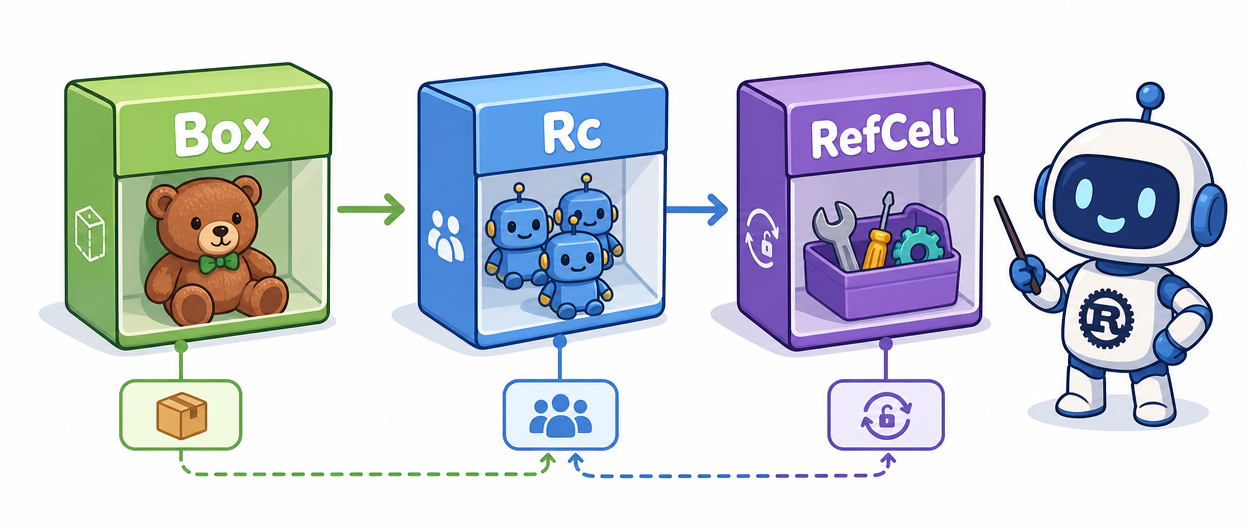
Let me tell you something nobody warned me about when I started learning Rust: the borrow checker isn’t the hard part. Smart pointers are.
I spent three months fumbling through ownership like it was a new language—because it was. I’d come from biology, not computer science, and I kept expecting Rust to work like the Python I’d used for data analysis. It doesn’t. Around month four, something clicked. I stopped thinking about “memory” as this abstract cloud and started picturing it as a very specific, tangible thing.
Mailboxes.
That’s my analogy, and I stick by it. Your computer’s memory is like a street full of mailboxes. Each one holds a value, and you need to know whose mailbox you’re checking when you write code. Sometimes you want the box yourself. Sometimes you’re just borrowing someone else’s key. Sometimes you need five people to have keys to the same box.
Smart pointers are the mechanism Rust gives you to manage all that key distribution.
Contents
- What Are Smart Pointers
- Box
: When You Need a Real Box - Rc
: Multiple Owners, Multiple Headaches - RefCell
: Selective Rebellion - The Combo: Rc<RefCell
> - Weak
: Breaking the Cycle - The Philosophy Underneath
- FAQ
Quick Concept Reference
- Ownership: Each value in Rust has exactly one owner; when the owner goes out of scope, the value is dropped
- Borrowing: Accessing a value via reference without transferring ownership; either shared (&) or mutable (&mut)
- Lifetime: The scope for which a reference is valid; compiler ensures no dangling references
- Smart Pointer: Data structures implementing Deref/Drop traits with more capabilities than regular references
So What Are Smart Pointers?
Before diving in, let’s clear up some terminology that confused me for way too long.
A regular reference in Rust—like &x—is basically a loan. You borrow a value, you use it, you give it back. The compiler makes sure you don’t do anything stupid with it.
A smart pointer is different. It’s a type that acts like a reference but carries extra powers. The name is a bit dramatic, honestly. They’re not artificially intelligent or anything. They’re just data structures that manage memory according to certain rules. Two traits make this work: Deref and Drop.
Deref says “this type can be treated like a reference.” When you call .deref() on a Box, you get back the thing inside it. Simple enough.
Drop says “when this value goes out of scope, run this cleanup code.” This is Rust’s way of saying “I handle my own garbage.” No runtime garbage collector needed—you just describe what should happen when the value is done.
These two traits are the skeleton underneath everything smart-pointer-adjacent in Rust. Keep them in mind. They’ll come back.
Box: When You Need a Real Box
The most straightforward smart pointer is Box<T>. You reach for it in three situations.
The first: recursive types. Here’s the thing about memory layout—types that contain themselves need a known size at compile time. A linked list node has a reference to the next node. But if that reference is just a normal field, the compiler can’t figure out how much space to reserve.
enum List {
    Cons(i32, Box<List>),
    Nil,
}

let _list = List::Cons(1, Box::new(List::Cons(2, Box::new(List::Nil))));
The Box breaks the circular dependency by putting the List on the heap instead of inline. The compiler only needs to know the size of a pointer.
The second: trait objects. If you want different implementations at runtime—like a plugin system or a UI with swappable components—you can’t know the concrete type at compile time. Box<dyn Trait> is how you say “I don’t know exactly which type here, but I know it implements this interface.”
The third: zero-cost abstraction in FFI. When you’re calling C code, sometimes you just need to pass data to a function that expects a pointer. Box gives you a clean way to manage that heap allocation from Rust’s side.
Most of the code I wrote early on didn’t need Box much. That’s normal. But when you need it, you really need it.
Want to see Box in real production code? Follow us on WeChat and reply ‘Box’ to get our curated Rust smart pointers codebase.
Rc: Multiple Owners, Multiple Headaches
Here’s where things got weird for me.
The standard ownership model says one value has one owner. When the owner goes out of scope, the value is dropped. Simple. Clean.
Except sometimes you genuinely need multiple parts of your program to share access to the same data. Maybe you have a tree structure where parent and children both need references to each other. Maybe you’re building a cache where several components access the same underlying data.
Rc<T>—reference count—is Rust’s answer. It wraps a value and keeps track of how many “clones” exist. When the last one is dropped, the value goes too.
use std::rc::Rc;

let shared_data = Rc::new(vec![1, 2, 3]);

let clone1 = Rc::clone(&shared_data);
let clone2 = Rc::clone(&shared_data);

println!("{:?}", shared_data); // All three see the same data
The thing that tripped me up initially: Rc is for immutable sharing only. The moment you try to mutate through an Rc, Rust stops you dead. That’s not a limitation—it’s a feature. If two parts of your code could mutate the same data simultaneously, you’d have race conditions. Rust doesn’t allow that.
But—and this took me a while to fully appreciate—sometimes you really do need mutable access through a shared reference. That’s where RefCell comes in.
Single-threaded read-only sharing has its limits. In the next section, we’ll see how to ‘break the rules’ with RefCell — Reply ‘Interior Mutability’ on our WeChat to get my personal study notes.
RefCell: Selective Rebellion
RefCell<T> is the interesting one. It basically says: “I don’t trust the compiler to track aliasing at compile time, so I’ll handle it myself at runtime instead.”
When you call .borrow() on a RefCell, you get an immutable reference. When you call .borrow_mut(), you get a mutable one. Internally, RefCell keeps track of how many references are active and panics if you try to violate the rules—like trying to mutably borrow something that’s already borrowed.
use std::cell::RefCell;

let data = RefCell::new(vec![1, 2, 3]);

data.borrow_mut().push(4); // Mutate through RefCell
println!("{:?}", data.borrow()); // Immutable borrow to read
The nice thing: RefCell lets you cheat the ownership rules in controlled ways. The dangerous thing: you can cause panics at runtime instead of compile errors.
There’s a mental shift here. Usually Rust moves errors to compile time, which is great. RefCell moves some of that checking to runtime. It’s a trade-off, and it’s worth understanding when you’re making that trade.
The Combo: Rc<RefCell>
Here’s a pattern I used constantly once I understood it: Rc<RefCell<T>>. This is “multiple ownership plus mutable access.” You get shared data that any clone can mutate.
use std::rc::Rc;
use std::cell::RefCell;

let shared = Rc::new(RefCell::new(vec![1, 2, 3]));

let clone1 = Rc::clone(&shared);
clone1.borrow_mut().push(4); // Mutate from clone1

println!("{:?}", shared.borrow()); // Original sees the change
This saved my bacon more times than I can count. When I needed something like a mutable global variable—but obviously I didn’t want actual global mutable state—I could pass this combo around and have real mutation with shared ownership.
The key insight: Rc handles the ownership counting, RefCell handles the mutability tracking. They’re solving different problems. Combining them solves both.
Weak: Breaking the Cycle
I hit a wall around month three that I couldn’t explain. I’d build these beautiful tree structures with Rc everywhere, and they’d work fine for a while. Then my program would leak memory—not a crash, just… keep using more and more RAM until I killed it.
The problem was reference cycles. Rc keeps data alive as long as any Rc points to it. But what if A points to B and B points back to A? Neither can ever be the “last” reference. The reference count never hits zero. The memory never gets reclaimed.
Rust doesn’t protect you from this automatically. The solution is Weak<T>—a reference that doesn’t contribute to the count.
use std::rc::{Rc, Weak};
use std::cell::RefCell;

struct Node {
    value: i32,
    parent: Weak<RefCell<Node>>,
    children: Vec<Rc<RefCell<Node>>>,
}
A Weak reference is like… actually, let me think of a good analogy. It’s like having a forwarding address instead of a lease. You can check if the place still exists, but you don’t keep it alive by virtue of knowing about it.
To use a Weak, you upgrade it to an Option<Rc<T>> with .upgrade(). This returns Some if the data is still alive, None if it’s been dropped. Handle both cases, and you’ve got safe cyclic data structures without the leak.
The Philosophy Underneath
After all this click-grinding, I started noticing something. Rust’s smart pointers aren’t accidents. They’re design choices made visible.
The language gives you ownership semantics because heap allocation isn’t free. When you allocate memory, you should know about it. When you share data, you should be intentional. When you’re done with something, it should be obvious when cleanup happens.
Box makes allocation explicit. Rc makes sharing explicit. RefCell makes mutation explicit. Weak makes cycles explicit.
The borrow checker exists to catch mistakes before they become bugs. Smart pointers exist to give you controlled ways past those checks when you genuinely need them. It’s not about being restrictive—it’s about being deliberate.
I don’t miss garbage collection anymore. Coming from Python, that surprised me. But watching Rust release memory the moment it’s done, no pauses, no overhead—it feels more natural than I’d expected.
Closing Thoughts
Three months of confusion sounds bad, but honestly? That confusion was the learning. I had to stop treating Rust like “C with training wheels” and start treating it like its own thing. The ownership model isn’t an obstacle to work around. It’s the point.
Smart pointers took the longest to click, but they also felt the most satisfying when they did. I keep a note on my desktop with the Rc<RefCell<T>> pattern now, because I refer to it constantly—not because I forget how it works, but because using it is still a small win every time.
If you’re stuck, I’d say this: find your mailbox analogy. Something physical, something that makes sense in your head. Memory management abstractions become much less abstract when you have a concrete model underneath them.
And if your first smart pointer program doesn’t compile? That’s fine. Mine didn’t either.
Congratulations on unlocking the Big Three of Rust smart pointers! But this is just the beginning — Follow us and reply ‘ARC’ to get notified when we cover Atomic reference counting Arc and Mutex for multi-threaded scenarios next week!
FAQ
What is Box in Rust and when should I use it?
Box
What’s the main difference between Rc and Box?
Box
How does RefCell achieve mutability at runtime?
RefCell
When should I use the Rc<RefCell> combo?
Use it when you need multiple owners to share data AND some of those owners need to mutate the data—common in graph structures, caches, or observer patterns.
Can Rc be shared across threads?
No, Rc
See, through these vivid ’toy boxes’, Rust’s ownership and memory management suddenly becomes crystal clear, doesn’t it?
Follow ‘Dream Beast Programming’ on WeChat for ongoing Rust, AI, and tool tutorials. See you next time!
📖 阅读中文版:Rust智能指针详解:Box、Rc与RefCell的实用指南