PostgreSQL 18 Asynchronous IO Revolution: Why This Is the Biggest Database Update in 5 Years
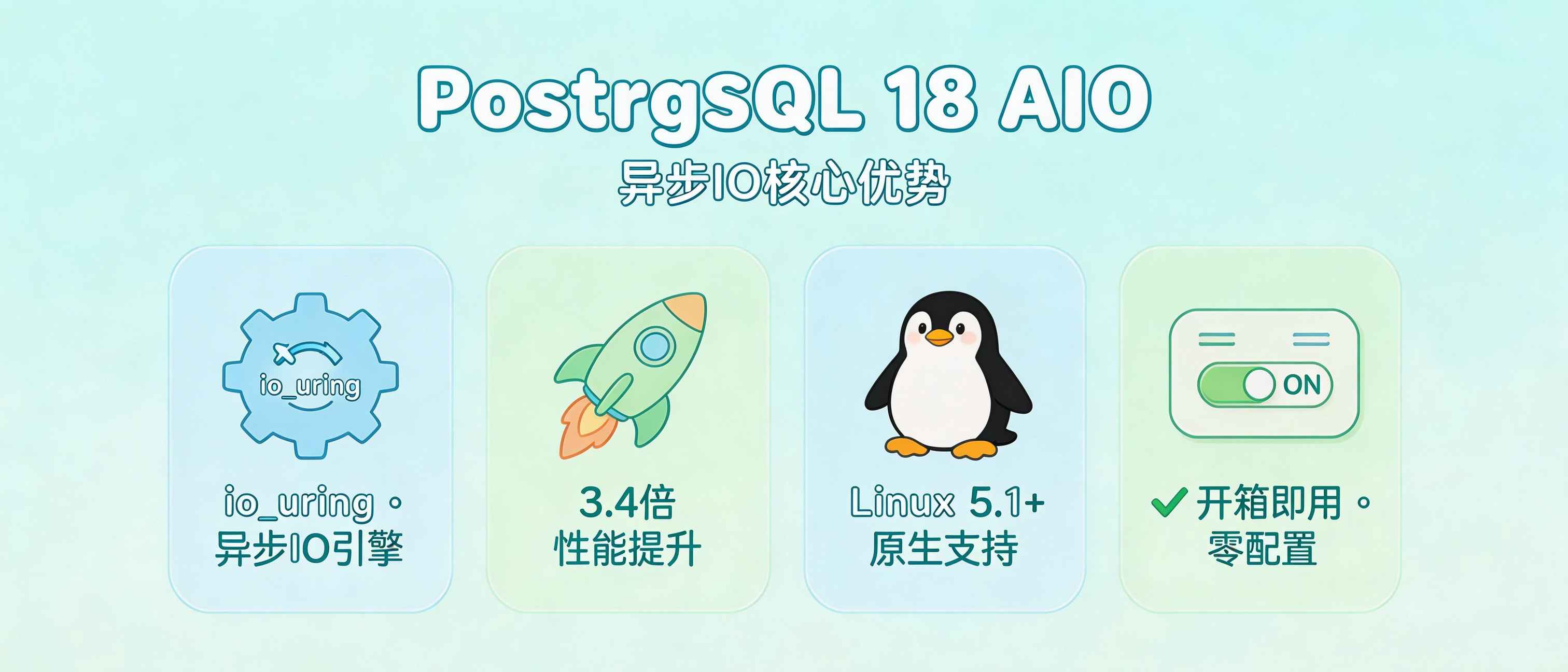
Table of Contents
- Traditional I/O: Banking Queue Style
- Asynchronous I/O: Modern Restaurant Experience
- io_uring: Linux Kernel’s “Express Lane”
- PostgreSQL 18’s “Magic Fusion”
- Real Performance: Does It Live Up to the Hype?
- How to Enable This “Secret Weapon”
- More Than Just Asynchronous I/O
- When Should You Upgrade?
- Potential Pitfalls to Watch For
- Frequently Asked Questions (FAQ)
- Final Thoughts
Ever find yourself staring at a database that seems to have plenty of CPU headroom, memory to spare, but query performance just won’t budge? Especially as data grows, each query starts feeling like rush hour subway traffic—slow, congested, and painfully frustrating.
I’ve been there. After digging into performance bottlenecks, I discovered the culprit was often I/O operations. When a database needs to read data from disk, traditional approaches are like borrowing books from a library one at a time—you can’t get the next one until you return the first. Not exactly efficient.
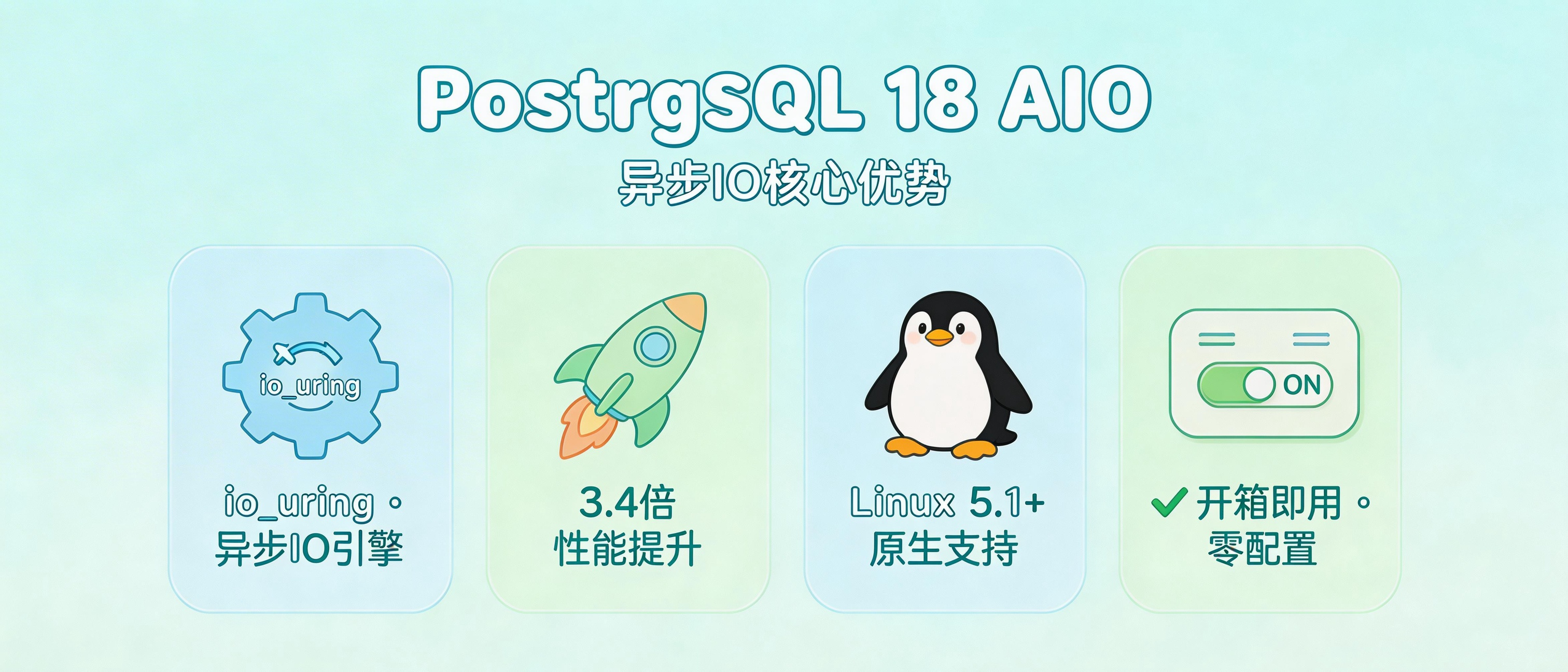
But here’s the exciting news: PostgreSQL 18 has officially landed, bringing what might be the most significant update in years—asynchronous I/O (AIO). This isn’t some minor patchwork; it’s a five-year engineering effort from the PostgreSQL team that fundamentally changes how databases interact with storage.
Traditional I/O: Banking Queue Style
Let’s talk about how traditional I/O works. Imagine going to a bank.
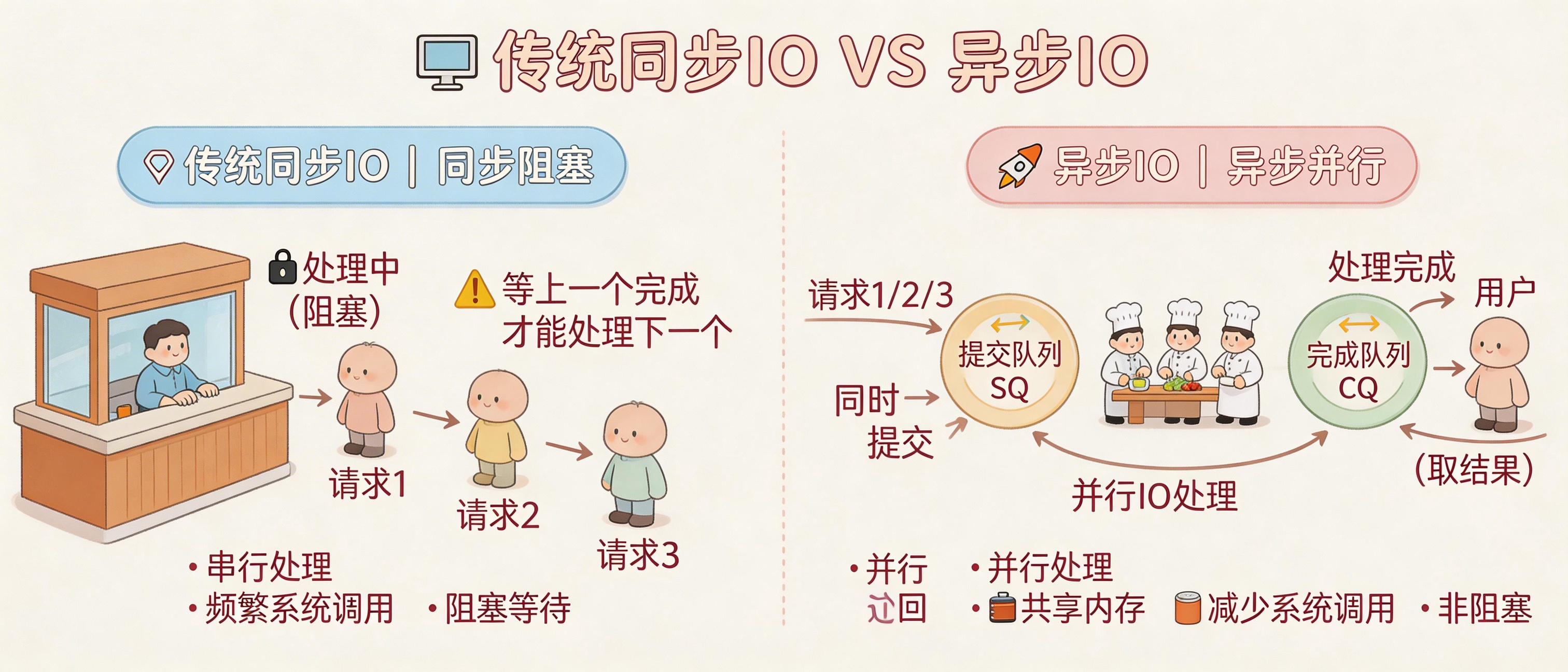
Traditional synchronous blocking I/O feels like taking a number and waiting. Your number gets called, you go to the teller, complete your transaction, then go back to waiting for the next call. During this whole process, you’re just sitting there, unable to do anything else. That’s synchronous blocking I/O—one request must complete before the next begins.
Later, banks introduced “appointment + queue” systems, similar to epoll. You can monitor multiple services simultaneously, handling whichever becomes available first. Better than before, but there’s still a problem—every time you need service, you still have to physically go to the counter (system call).
Asynchronous I/O: Modern Restaurant Experience
So what does asynchronous I/O feel like? Think of a modern restaurant experience.
You sit down, scan a QR code to order. After ordering, you chat with friends, check your phone. The kitchen receives your order and starts cooking. When it’s ready, the server brings it to your table. You don’t need to know what’s happening in the kitchen, nor repeatedly ask “is my food ready yet?”
That’s the essence of asynchronous I/O: you submit I/O requests, continue with other tasks, and the system notifies you when results are ready. Your program isn’t blocked and can handle other work.
io_uring: Linux Kernel’s “Express Lane”
In the Linux world, the primary solution for asynchronous I/O is io_uring. Introduced in Linux kernel 5.1, it’s specifically designed to address various pain points of traditional async I/O approaches.
io_uring’s design is particularly clever. It establishes two ring buffers between your program and the kernel:
- Submission Queue (SQ): You place I/O requests here, like dropping orders onto a conveyor belt
- Completion Queue (CQ): Processed request results return through here, like finished dishes coming out on a conveyor
Here’s the key—these buffers are shared memory! This means your program can write requests directly, and the kernel can read them directly, with minimal system calls needed. Only when you need to notify the kernel “I have new requests” or “I’m collecting results” do you need a few system calls.
This design dramatically reduces the overhead of switching between user space and kernel space, making I/O operations unprecedentedly efficient.
PostgreSQL 18’s “Magic Fusion”
The most exciting aspect of PostgreSQL 18 is its integration of io_uring—this “game-changer” is now built into the database.
Previously, PostgreSQL’s I/O operations, despite various optimizations, were essentially synchronous. Now, with io_uring support, PostgreSQL can truly implement asynchronous I/O.
What does this mean in practice? Consider when a database needs to read data from disk:
- Before: Read one at a time, wait for completion before next read
- Now: Submit a batch of read requests, continue processing other transactions, return when data is ready
For OLTP (Online Transaction Processing) scenarios, this change is like a “rocket booster” for performance. Especially for I/O-intensive applications like e-commerce platforms or social networks, the improvements can be substantial.
Real Performance: Does It Live Up to the Hype?
I know what you’re thinking: sounds great, but what are the actual numbers?
According to community test data, PostgreSQL 18’s asynchronous I/O delivers significant performance improvements in certain scenarios:
- Sequential scans: 3.4x faster
- Index scans: 2.1x faster
- Concurrent queries: P95 latency reduced by 25% in high-concurrency scenarios
Of course, your actual improvement depends on your specific use case. If your application wasn’t I/O-bound to begin with, you might not notice dramatic changes. But for I/O-intensive workloads, the gains can be substantial. According to PostgreSQL community testing, random read performance on NVMe SSDs can improve by 5x or more in some scenarios.
How to Enable This “Secret Weapon”
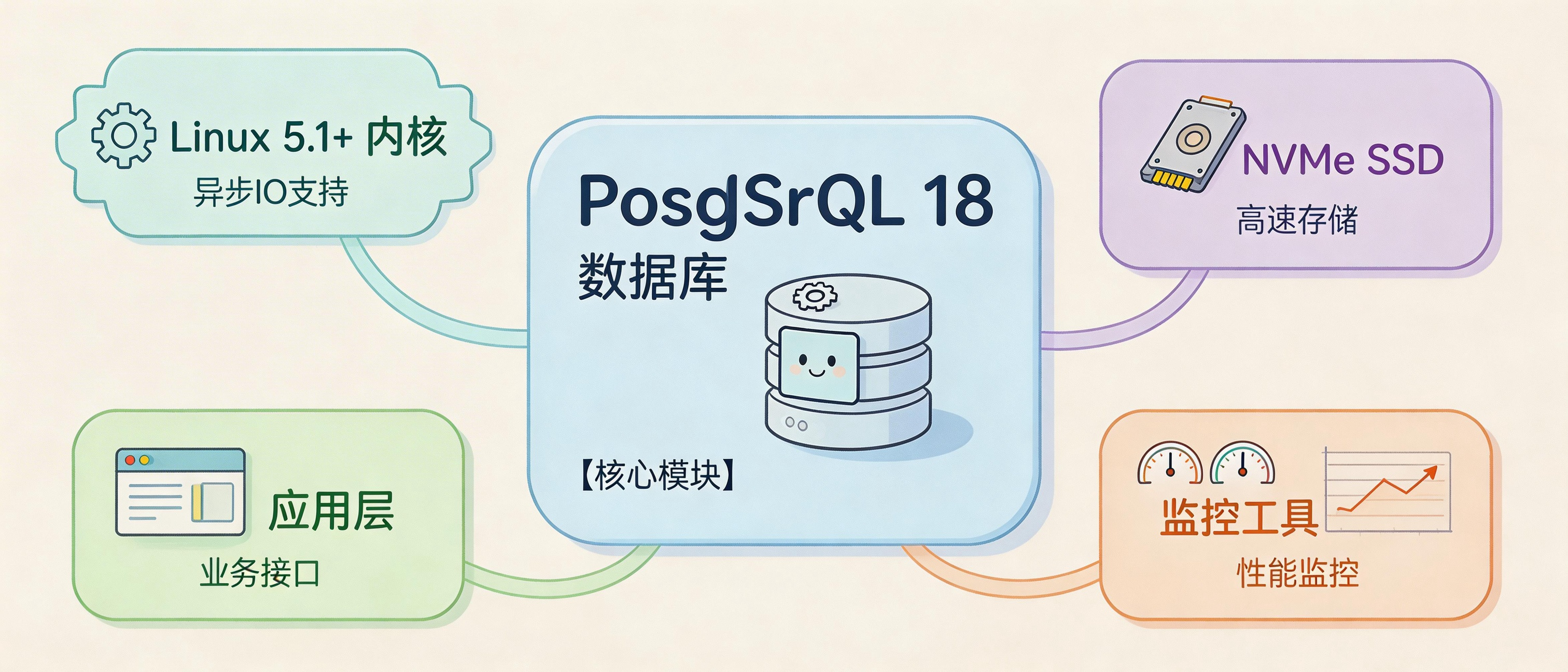
The good news is PostgreSQL 18’s asynchronous I/O support works out of the box. According to PostgreSQL official documentation, as long as you’re running on Linux kernel 5.1 or newer, and compiled PostgreSQL with io_uring support enabled, it will automatically use asynchronous I/O.
A few important considerations:
- Kernel version: Must be Linux 5.1+, with newer versions recommended as io_uring has received optimizations in subsequent kernels
- Compilation options: Need to add
--with-io-uringwhen compiling PostgreSQL - Configuration parameters: You can adjust async I/O related parameters in
postgresql.conf, such asio_uring_queue_depthto control queue depth
More Than Just Asynchronous I/O
While asynchronous I/O is PostgreSQL 18’s headline feature, it’s not the only update. This release brings several other improvements:
- Parallel query optimization: Better parallel execution plans for faster complex queries
- Monitoring enhancements: More granular I/O statistics for precise bottleneck identification
- Security improvements: Stronger encryption support and access controls
Honestly though, these updates feel like “supporting actors” next to the asynchronous I/O showstopper.
When Should You Upgrade?
Reading this, you’re probably wondering about timing. Here’s my advice:
Upgrade now if:
- Your application is I/O-intensive with significant read/write operations
- You use PostgreSQL for real-time analytics with demanding query speed requirements
- Your servers run relatively new Linux kernels (5.1+)
- You’re planning new projects and want the latest technology stack
Consider waiting if:
- Your application is stable with adequate performance, and you want to minimize upgrade risk
- Your server kernel versions are too old, making upgrades costly
- You don’t have significant async I/O needs and current versions meet all requirements
Potential Pitfalls to Watch For
If you decide to upgrade, watch out for these challenges:
Buffer management: Asynchronous I/O means once you hand buffers to the system, you can’t touch them until operations complete. This requires some adaptation in programming models.
Debugging complexity: Because operations are asynchronous, stack traces when issues occur may be less intuitive. Consider adding more logging and leveraging monitoring tools.
Compatibility considerations: While PostgreSQL 18 maintains backward compatibility, any major version upgrade can introduce subtle changes. Thorough testing before production deployment is essential.
Frequently Asked Questions (FAQ)
Q1: What hardware requirements does PostgreSQL 18’s asynchronous I/O have? A: The main requirement is kernel support—Linux 5.1 or newer, with 5.10+ recommended for better stability. Hardware-wise, SSDs or NVMe drives maximize async I/O benefits, but traditional hard drives can still see improvements.
Q2: Does asynchronous I/O add complexity to database operations? A: For users, complexity is minimal. PostgreSQL automatically manages async I/O details—you don’t need to modify application code. The main considerations are at the ops level: monitoring new metrics and configuration parameters.
Q3: What should I watch for when upgrading from older PostgreSQL versions? A: Always test thoroughly in staging first. Check for incompatible plugins or tools. Data backup is mandatory—major version upgrades always carry some risk, so have a rollback plan ready.
Final Thoughts
PostgreSQL 18’s asynchronous I/O support represents more than just performance gains—it signals a direction for database technology evolution: more efficient utilization of modern hardware capabilities.
As SSDs become ubiquitous and NVMe becomes standard, traditional synchronous I/O models increasingly struggle to keep pace with hardware advancements. Asynchronous I/O addresses this fundamental mismatch.
For developers, this means we can process more data with fewer resources and deliver faster responses. It’s not just technical progress—it creates business opportunities.
If you haven’t been paying attention to PostgreSQL 18, now’s the time. Check the official documentation, experiment with the new features. You might find that performance bottleneck you’ve been wrestling with quietly disappears.
That wraps up our discussion on PostgreSQL 18’s asynchronous I/O. If you encounter issues during upgrades or have experiences to share, please leave a comment. Let’s learn from each other.
I’ll continue writing about databases and performance optimization. If these topics interest you, consider following along. Until next time.