0. A Counter-Intuitive Fact
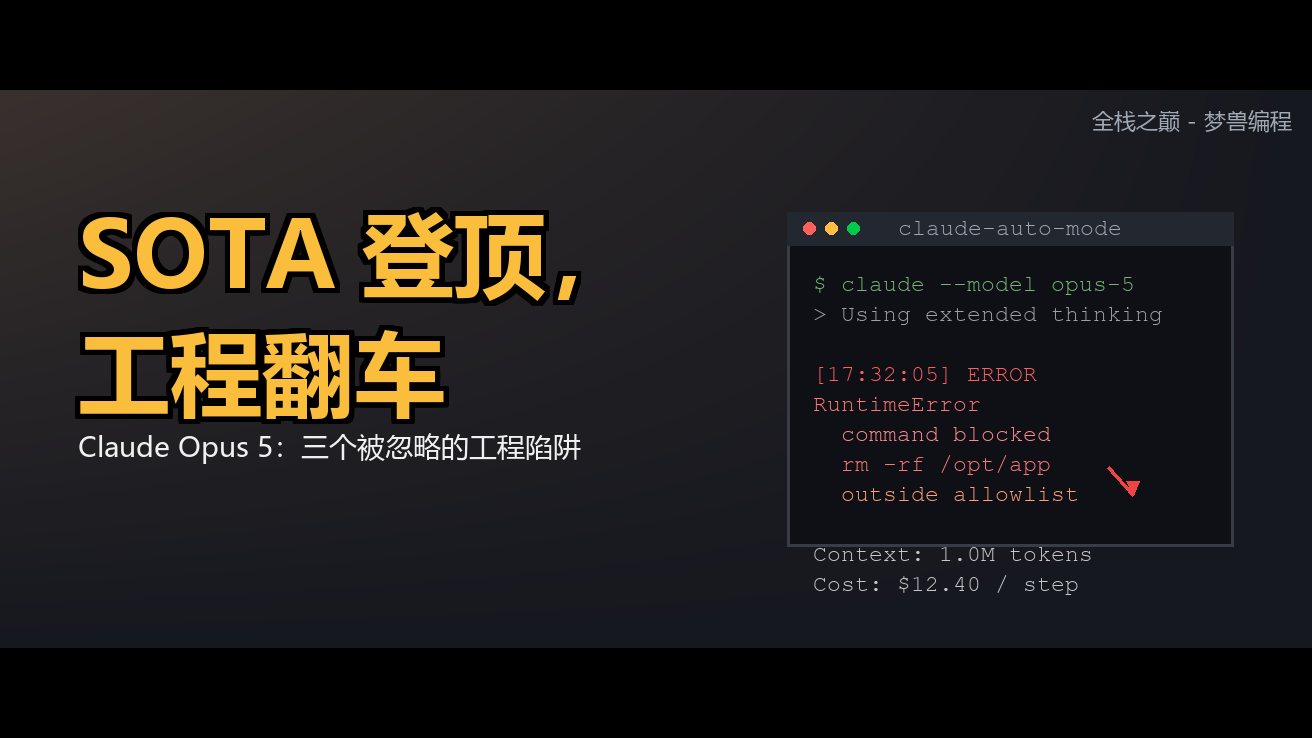
On July 24, 2026, Anthropic released Claude Opus 5. By the end of the day it had hit the top of Hacker News: 1,500+ points and 837 comments.
The capital-market reading is simple: Opus 5 delivers near-Fable 5 coding performance at half the price. But after going through both the official announcement and the HN discussion, I think the more counter-intuitive conclusion is this:
It is not the benchmark numbers that matter most. What matters is that the model is starting to make decisions you would not previously have outsourced.
When given a machine-part drawing and no direct tool to read it, Opus 5 wrote its own computer-vision pipeline, extracted geometry from raw pixels, and reconstructed a 3D FreeCAD model.
When shown a real bug in a popular open-source package manager, it fixed the root cause and an edge case the community patch had missed.
When asked by a trading-firm engineer to build a market-data feed for a new exchange, it built its own test harness because no live feed was available to validate against.
What these examples share: the model is no longer just “helping you write code.” It is demonstrating that it can independently complete a process you cannot fully see.
The question shifts from “can it write this correctly?” to “are you willing to let it run on its own?”
Opus 5 turns fuzzy problems into deliverable standards.
This article does not repeat the official benchmarks. It answers three questions:
- Where exactly does Opus 5’s autonomy jump happen?
- How does pricing change now that the model is more proactive?
- What three engineering habits should developers adjust immediately?
1. Behind the Frontier-Bench #1 Ranking
Anthropic listed the usual benchmarks: Frontier-Bench v0.1 SOTA, CursorBench 3.2 close to Fable 5, AA Coding Agent Index leadership, OSWorld 2.0 cost advantage, and so on.
But the three case studies are what made me stop scrolling.
Case 1: From a drawing to a 3D FreeCAD model
The task was to generate FreeCAD code that rebuilt a machine part from a drawing. The catch: the model was intentionally not given a tool that could read the drawing directly.
Opus 5’s response was to write its own computer-vision pipeline, extract geometry from the raw pixels, and reconstruct the complete part. It did this repeatedly and reliably.
Other competing models failed every attempt under the same constraints.
Case 2: Fixing the root cause, not the symptom
Given a real bug in a popular open-source package manager, Opus 5 found the root cause and fixed an edge case that the community patch had missed.
Another model fixed only the surface symptom and reported the bug resolved.
Case 3: No live feed? Build a validator
A trading-firm engineer used Opus 5 to build a market-data feed for a new exchange. Previous models could not complete the task even with detailed human plans.
Finding no live feed to validate against, Opus 5 built its own test harness to verify that its code parsed the exchange’s data correctly.
What these three cases reveal
The leap is not that it writes better code. It is that when external validation is unavailable, it constructs its own internal validation loop.
In traditional software development we distrust self-validation: tests written by the same person who wrote the code can hide bugs. But in agent scenarios, when external validation is missing, the ability to create an internal verification mechanism can determine whether a task can be completed independently.
This is the real difference between Opus 5 and earlier models:
| Capability level | Older models | Opus 5 |
|---|---|---|
| Writing code | Output according to prompt | Actively complete toward a goal |
| Debugging | Fix the given location | Trace to root cause |
| Validation | Rely on external harness | Build its own harness |
| Failure mode | Stuck | Route around the blocker |
Lesson 1: Opus 5’s competitive edge is not code quality; it is the ability to autonomously close the loop.
2. After the Price Cut, Where Does the Real Cost Hide?
Anthropic made it clear: Opus 5 is the new default on Claude Max and the strongest model on Claude Pro. The headline is that it costs half as much as Fable 5.
But “half the price” has two meanings.
The visible one: your API bill goes down.
The invisible one: the model tends to take more autonomous steps to finish a goal. This means a single task may consume more tokens, but the intelligence per token is higher, so the cost per correct deliverable drops.
This creates a tension every developer will face:
The bill for a single run may go up, while the cost per deliverable goes down.
This comes from Anthropic’s effort-setting mechanism: you can tune the model between maximum intelligence and speed/cost. At max effort it is smartest and most expensive; at minimum effort it still passes more tasks than other models.
It resembles Claude Code’s --approve flag. You are no longer controlling the cost of each step; you are controlling how far the model is allowed to go on a task.
Lesson 2: With Opus 5, cost control shifts from “pay per token” to “pay per task boundary.”
You need to rethink three things:
- Which tasks can you let it finish without supervision?
- Which tasks must require human sign-off on every diff?
- Which tasks should have a verification harness you design, rather than one the model designs?
3. Three Engineering Habits to Change Now
Opus 5 is not a “better tool.” It is a more capable intern. Capability and risk rise together.
3.1 Habit 1: Tier your trust, do not trust uniformly
Not every task needs the same level of supervision.
| Tier | Characteristic | How to use Opus 5 |
|---|---|---|
| White-box | You already know how to do it, you just do not want to write it | Let it run, review the diff |
| Gray-box | You know the direction, but the details are uncertain | Give a goal, require verification at each step |
| Black-box | You are not sure it can be done at all | Bound the scope, enforce checkpoints |
Opus 5 is most valuable in the black-box tier and most dangerous there too. Never let it quietly finish a black-box task.
3.2 Habit 2: Maintain a failure-mode checklist
A stronger model does not mean it cannot fail in a way that looks normal.
The package-manager example is the warning: Opus 5 fixed the root cause, another model fixed only the symptom. If your review only checks “does the bug appear to be gone?”, you can be fooled by a surface-level fix.
Keep a checklist for each project:
- At which step is this task most likely to succeed falsely?
- Which outputs must be validated by an external tool?
- Which errors does the model tend to quietly workaround rather than truly fix?
3.3 Habit 3: Rewrite prompts from instructions to success criteria
Old prompt style:
“Help me write a FreeCAD script to rebuild this part.”
New prompt style:
“This part needs to be reconstructed as a FreeCAD model. The only input is an image; no direct measurement data is available. Your goal is to produce a geometrically correct model and validate dimensional plausibility by some means.”
The difference: the second defines success criteria without constraining the path. Opus 5 needs that room.
But this also means your acceptance criteria must be sharp. Otherwise it will give you a solution that “looks done.”
4. The Three Voices Worth Hearing on HN
HN comments are usually dirtier and more honest than press releases. After scanning 800+ comments, three camps stood out.
4.1 The benchmark skeptics
They point out the gap between benchmark SOTA and real production codebases. They are right.
My view: Opus 5’s progress lies in “solving problems where the tooling is not explicitly provided,” which transfers better to real engineering than raw benchmark scores do.
4.2 The cost-anxiety camp
They worry that stronger models mean more expensive single runs and easier vendor lock-in. This is partly valid.
But the lock-in may not be price; it may be that you become unwilling to go back to hand-holding a model through every step.
4.3 The pragmatists
The most-upvoted comments sound like:
“I used it for X, it took Y steps, Z seconds, saved N hours, but missed one edge case.”
This is the feedback that matters. Opus 5 is not valuable because it tops a leaderboard; it is valuable if it can consistently reduce the number of steps that require your attention by 50% or more in your real codebase.
5. If You Use It Tomorrow, Start Here
Do not replace your existing Claude Code workflow with Opus 5. Use it first for three kinds of tasks:
- Exploratory refactoring where you are unsure of the approach and want to see multiple paths quickly.
- End-to-end small tools such as scripts, CLIs, or internal utilities built from scratch.
- Hard-to-reproduce bug diagnosis involving unusual environments or tricky reproduction steps.
In these tasks, track two metrics:
- The number of verification steps it proposes on its own: more is better.
- The shape of its failures: does it get stuck, hallucinate, or quietly workaround?
Lesson 3: The right way to use Opus 5 is not “execute more intelligently” but “delegate more boldly.”
6. Final Thought
Model capability leaderboards will keep updating. After Opus 5 will come Opus 6, Fable 6, Kimi K4.
What catches my attention this time is that the model is solving problems that are not “harder” but fuzzier. Fuzzy problems do not have standard answers; they only have delivery standards.
The core engineering competency is shifting from “writing correct code” to “defining what correct code means.”
That is more important than any benchmark.
About the author
全栈之巅 - 梦兽编程 (Full Stack Peak - Dream Beast Programming) focuses on AI coding tools, agent engineering, and developer productivity. This article draws on Anthropic’s official announcement and public Hacker News discussion; the analysis is independent.