Rust Design Patterns: 3 Best Practices Senior Backend Engineers Always Use
 The Rust compiler as a guardian, protecting code from errors
You Can Tell in Five Minutes If Someone Really Gets Rust
After doing Rust backend development for a while, you’ll notice something: there’s a huge gap between people who truly understand Rust and those who just barely get their code to compile.
It’s not about how well they memorize syntax. It’s not about how fast they fix borrow checker errors.
It’s about the shape of their code.
Senior backend engineers write Rust in a particular way: quietly, intentionally. Their code looks a bit boring, even plain.
But that “boring” quality is exactly what makes code survive production’s hammer blows and stay readable six months later.
These three Rust design patterns are what I see repeatedly in senior engineers’ code. Most developers never notice them—until production teaches them the hard way.
Rust Design Pattern 1: Newtype Makes Invalid States Impossible
Junior Rust developers love runtime checks everywhere. Senior engineers do something more radical: they make invalid states impossible to exist in the first place.
Look at this example:
struct User {
    id: String,
    email: String,
}
Looks fine? Wait until you hit a production bug. This code allows empty IDs, invalid emails, and half-constructed user objects.
Now watch the senior version:
struct UserId(String);
struct Email(String);

struct User {
    id: UserId,
    email: Email,
}

impl User {
    fn new(id: UserId, email: Email) -> Self {
        User { id, email }
    }
}
This uses Rust’s Newtype pattern, wrapping a plain String into a dedicated type. This is the essence of Rust type safety.
What’s the benefit? Validation happens once, then the compiler enforces correct types. Want to pass a raw string? Sorry, the compiler blocks you.
It’s like your building’s access card system—not just any card works, it has to be specifically authorized.
 Rust Newtype pattern works like an access control system, only letting validated types through
Senior engineers don’t add checks everywhere—they kill the possibility of misuse. That’s the core idea of Rust best practices.
Rust Design Pattern 2: Rust Ownership Is Your System Architecture Blueprint
Many people fight Rust’s ownership system. Senior engineers use it as a design tool. This is the most overlooked point in Rust best practices.
Look at this API handler:
fn handle(req: Request) {
    process(req);
    log(req);
}
Won’t compile? Yeah, exactly.
A junior’s first reaction: “I’ll just clone it.” But a senior engineer pauses to think: Who should own this request? Does the process function consume it or just peek at it? What about the log function? Is the data flow clear?
The right approach might be borrowing:
fn handle(req: &Request) {
    process(req);
    log(req);
}
Or intentionally transferring ownership:
fn handle(req: Request) {
    let data = extract(req);
    process(data);
}
It’s like a package delivery—either you sign for it and look (borrowing), or you open it and take out the contents (ownership transfer). A package can’t be in the warehouse and with the customer at the same time.
Ownership reflects system data flow:
Request
  |
  v
Parser -> Domain -> Storage
Each arrow is an ownership transfer. No ambiguity, no accidental reuse.
Senior engineers let the ownership system expose architecture problems early, not when production explodes.
Rust Design Pattern 3: Enum Error Handling Makes Failures Predictable
Most Rust code treats errors as strings. Senior code treats them as state machines.
Common but terrible approach:
fn load(id: &str) -> Result<Data, String> {
    Err("not found".to_string())
}
This code is painful to maintain. You can’t determine error types, can’t handle them precisely—just print logs and stare helplessly.
Senior engineers write it like this:
enum LoadError {
    NotFound,
    Timeout,
    Corrupt,
}

fn load(id: &str) -> Result<Data, LoadError> {
    Err(LoadError::NotFound)
}
Then error handling becomes precise:
match load(id) {
    Ok(data) => use_data(data),
    Err(LoadError::NotFound) => recover(),
    Err(e) => fail(e),
}
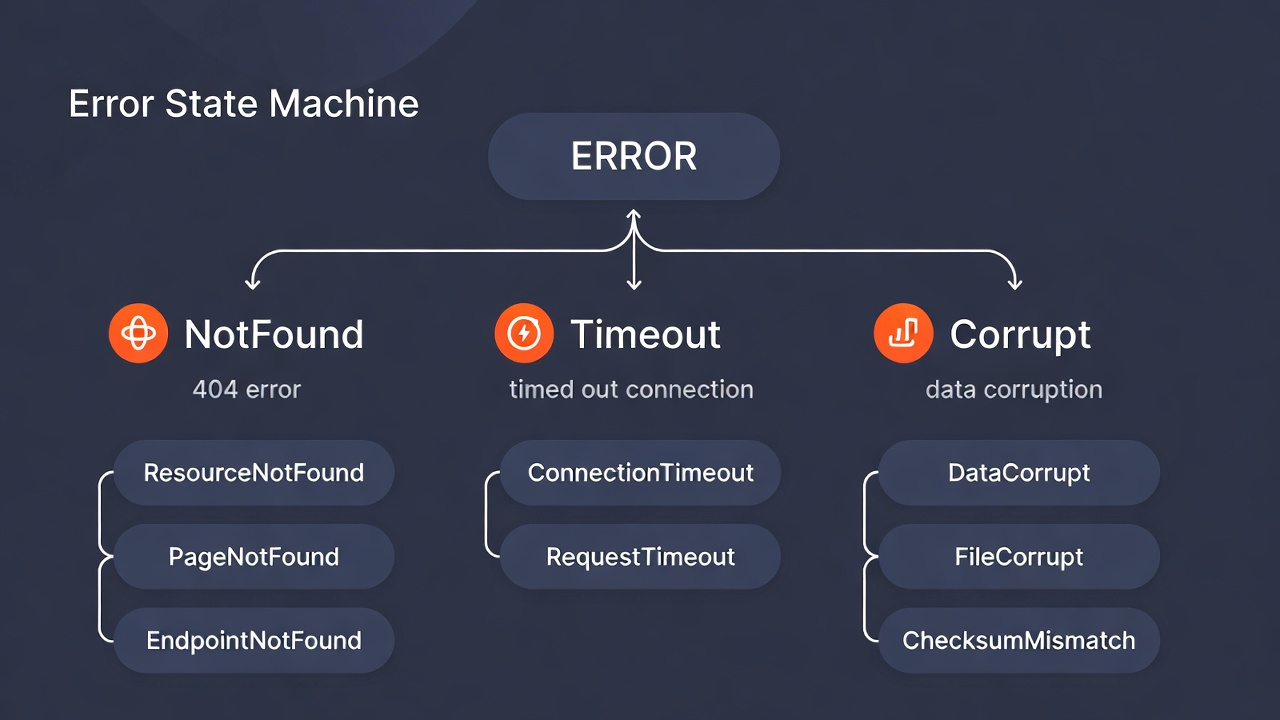 Rust enum error handling makes failure paths crystal clear, each error is an independent state
It’s like going to the doctor—you can’t just say “I don’t feel well.” You need to specify if it’s a cold or gastritis to get the right treatment.
Why Rust Design Patterns Matter Especially in Backend Development
You know what backend development fears most? Not slow code—it’s getting woken up at midnight because production crashed.
When traffic spikes, dependencies wobble, data formats go wild—that’s when you realize: Rust won’t automatically save you. What saves you is how you thought about it beforehand.
These three Rust design patterns boil down to one thing: move problems that would only show up at runtime to compile time. Think about it—the compiler telling you what’s wrong while you code beats getting woken up at 3 AM to read logs, right?
Why do senior engineers stay so calm during incidents? Not because they have nerves of steel—it’s because they already forced the code to explain everything clearly.
Rust Best Practices: A Real Case Study
Let me tell you a true story. I had two Rust backend services. Service A used string errors with runtime checks everywhere. Service B used typed errors with Rust ownership boundaries.
The difference during load testing was stark. Service A would panic constantly, logs were a mess—couldn’t figure out what broke. Service B? Even its failures were graceful—where it failed, why it failed, how to recover, all crystal clear.
No magic. Just design differences.
Why Most People Miss These Patterns
Honestly, these patterns feel slow at first.
Creating types? Feels like ceremony. Designing ownership? Feels like fighting yourself. Enum errors? Feels like wasted time.
But wait. When the codebase grows, when new teammates join, when production crashes at 3 AM—you’ll realize how valuable that “slowness” was.
That’s when these patterns stop being academic exercises and become lifelines.
The Senior Engineer Mindset Shift
Senior backend engineers stop asking “How do I make this compile?” and start asking “What should be impossible here?”
Rust rewards this mindset brutally and beautifully. The compiler transforms from obstacle to partner.
Summary: The Core Thinking Behind Rust Design Patterns
Rust won’t automatically make you a senior engineer, but it will expose whether you think like one.
If your code relies on human discipline, it will eventually fail. If your code relies on structural design, the compiler will guard it for you.
That’s the difference most developers miss. And what senior engineers never miss.
Remember These Rust Best Practices
Golden Rule: Let the compiler guard your code, not human vigilance.
Quick Reference Cheat Sheet:
// 1. Newtype Pattern: Prevent invalid states
struct UserId(String);
struct Email(Validated);

// 2. Borrow vs Transfer: Think through data flow
fn handle(req: &Request) { /* read-only */ }
fn handle(req: Request) { /* transfer ownership */ }

// 3. Enum Errors: Make failures predictable
enum LoadError {
    NotFound,
    Timeout,
    Corrupt,
}
Did you find this article helpful?
- Like: If you found it useful, give it a thumbs up so more people can see these Rust design patterns
- Share: Share with friends or colleagues working with Rust
- Follow: Follow Dream Beast Programming for more backend engineering practices
- Comment: What’s your biggest pain point with Rust right now? Let’s discuss in the comments
Your support is my biggest motivation to keep creating!
Coming Next: These three Rust design patterns are just the foundation. Next, we’ll talk about how to combine them to build a Rust backend service that’s rock-solid in production. Stay tuned!
Further Reading & Related Rust Topics:
If you’re interested in Rust’s type system and error handling, these topics are worth diving into:
- View Original Article : English original “3 Rust Patterns Senior Backend Engineers Never Skip” by DevLogic
- Rust Ownership System Explained : Understanding Rust’s core memory model
- Rust Lifetimes : Making references safer
- Rust Async Programming : Tokio and async/await best practices
- Rust Macro Programming : Metaprogramming and code generation
- Rust Web Framework Comparison : Axum vs Actix-web vs Rocket
Note: Some links point to official Rust documentation and community resources for quick onboarding. More Rust practical tutorials are continuously being updated.