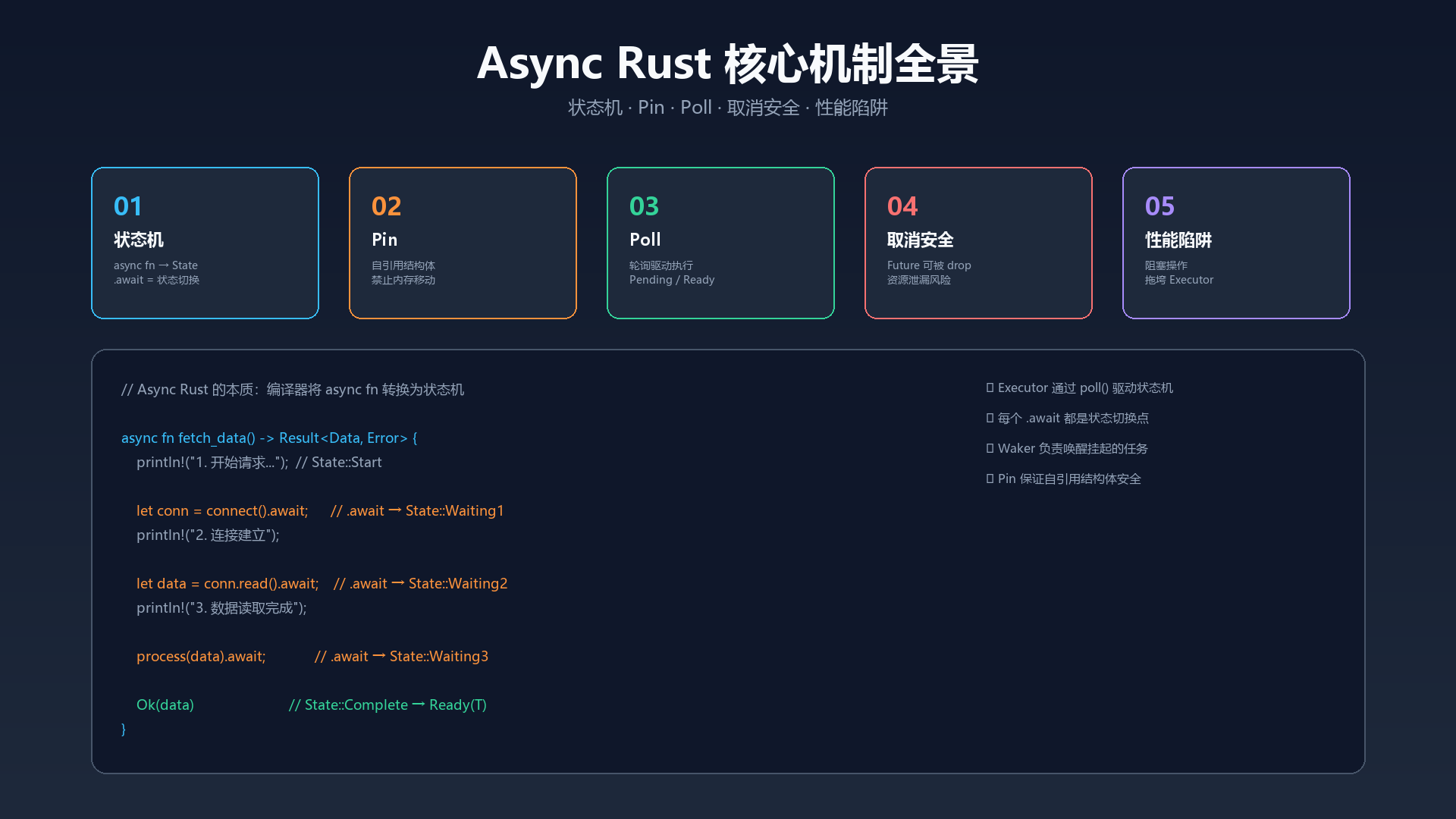
Why Does Async Rust Feel So Hard? A Deep Dive for Developers
Follow DreamBeast Programming and learn Rust with a smile
Async Rust is like a domineering CEO — glamorous on the outside, incredibly complex on the inside.
The first time you heard about it, your mind was filled with shiny labels like “high performance,” “zero-cost abstractions,” and “memory safety.” You excitedly opened your editor, wrote your first async fn, and then —
The compiler threw a screen full of red errors at you, filled with unfamiliar terms like Pin, Unpin, lifetime mismatch, and future cannot be sent between threads safely. You stared at the screen, feeling like you weren’t learning a modern language, but rather repairing a 1970s Soviet tractor.
Don’t panic, you’re not alone. Today’s article isn’t going to cover the “async/await starter pack” — those tutorials are everywhere. What I want to talk about is: Why does Async Rust feel so怀疑人生 despite being so powerful?
1. You Think You’re Writing Async Code, But You’re Actually Writing Systems Programming
In JavaScript, async programming is a “perk.” You write async/await, hand the rest to the V8 engine, and it stuffs your callbacks into the event loop, scheduling everything perfectly. You don’t need to know the difference between macro tasks and micro tasks — your code still runs smoothly.
In Go, it’s even more extreme. You just write the go keyword, and the runtime schedules goroutines as smoothly as Dove chocolate. You can even treat goroutines as “lightweight threads” without caring about how the underlying switching works.
But Rust doesn’t coddle you.
Rust’s async model is fundamentally low-level. Your async fn doesn’t turn into magic; the compiler brutally translates it into a state machine. Every .await point is a gear shift in that state machine. Your Future isn’t “executed” — it’s polled — like an impatient boss asking you “are you done yet?” every few seconds.
What does this mean? It means when you write Async Rust, you can’t just think “I want concurrency.” You also have to think about:
- Will this Future move in memory? (The Pin/Unpin problem)
- Will this lifetime still be alive after crossing
.await? - Will resources leak when this task is cancelled?
- What’s the scheduling strategy of this runtime (Tokio? async-std? smol?)?
In other words, Async Rust isn’t “writing async” — it’s “writing systems programming with async syntax.” It gives you C++-level control, but also shoves C++-level complexity in your face.
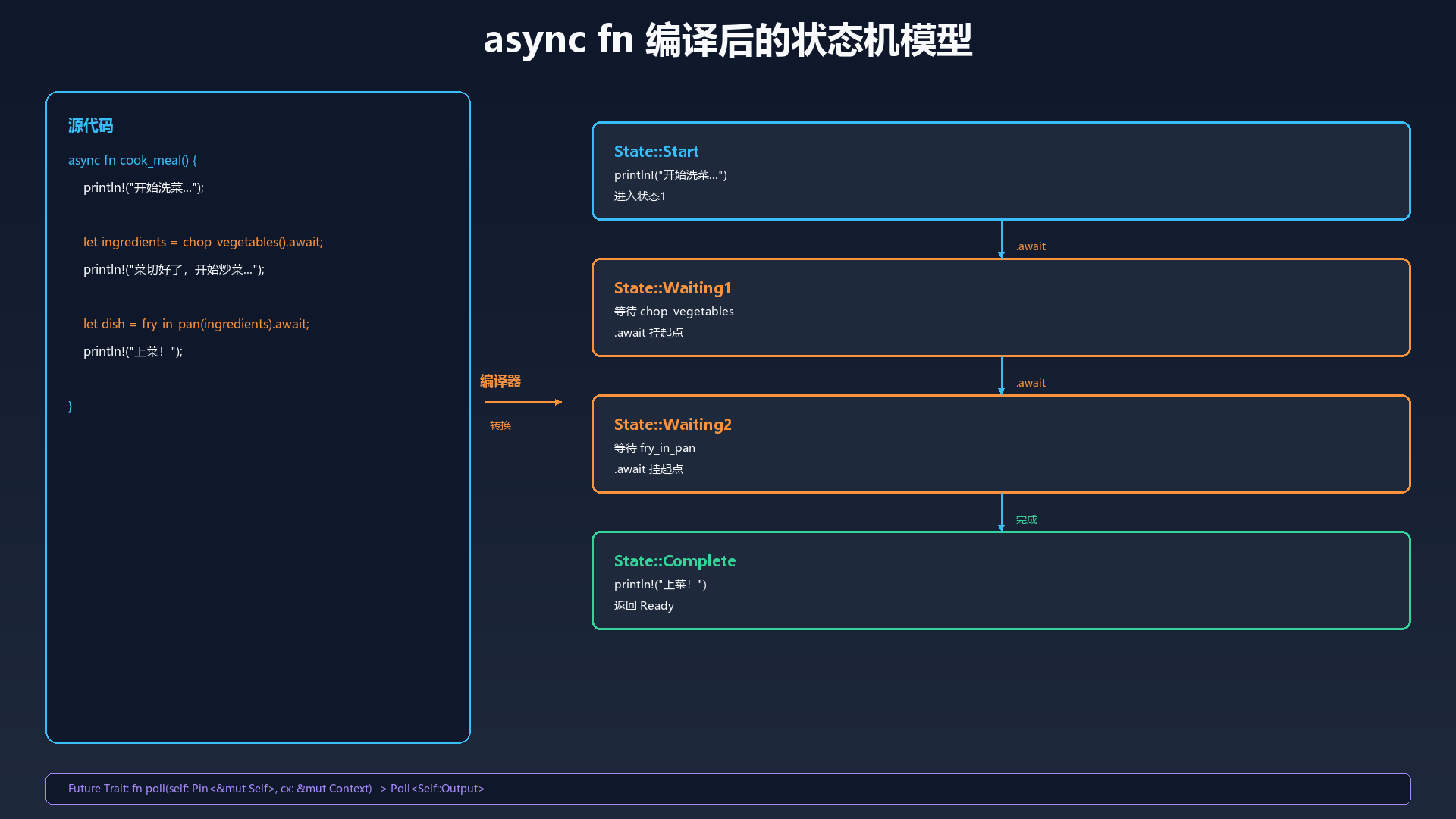
The diagram above shows how async fn is transformed by the compiler into a state machine model. Each .await point corresponds to a state switch, and local variables in the function become fields of the state machine. This is the truth behind the “seemingly synchronous” code you write.
Real-life Analogy: Buffet vs. Private Kitchen
JavaScript’s async is like a high-end buffet restaurant. You just hand over your plate, and the kitchen automatically prepares the dish, adjusts the heat, and serves it to your table. You don’t even need to know how many pots are in the kitchen.
Go’s async is like a fast-food chain. Standardized process — you place your order, and the system automatically distributes it to various windows, with stable and controllable serving speed.
Async Rust is like a private kitchen. The chef (you) has to personally decide when to turn on the fire, when to flip the food, and when to take the dish out of the oven. You can make Michelin-star-level cuisine, but if you forget to turn off the fire, the whole kitchen will burn down.
2. Ecosystem Fragmentation: Choosing Tokio or async-std? It’s a Political Question
Rust’s standard library still doesn’t have a built-in async runtime. What does this mean? It means the first step in writing async code isn’t writing code — it’s choosing a side.
Currently, there are mainly these factions on the market:
- Tokio faction: The largest ecosystem, almost the de facto standard. Nine out of ten networking libraries, database drivers, and web frameworks you want to use are built around Tokio.
- async-std faction: Design philosophy closer to the standard library, more elegant API, but relatively weak ecosystem.
- smol faction: Lightweight, modular, suitable for embedded or resource-constrained scenarios.
- embassy faction: Embedded-only, completely different dimension from the above.
This leads to a very awkward situation: Your async code is bound to a specific runtime from day one. You choose Tokio, and your entire tech stack is basically locked into the Tokio ecosystem. If you want to mix in an async-std library, congratulations — you might need to write a bunch of bridge code, or simply give up.
What’s even more outrageous is that some basic components — like async Mutex, File I/O, Timer — aren’t provided by the standard library. You have to find them in various runtime crates, and they’re not compatible with each other.
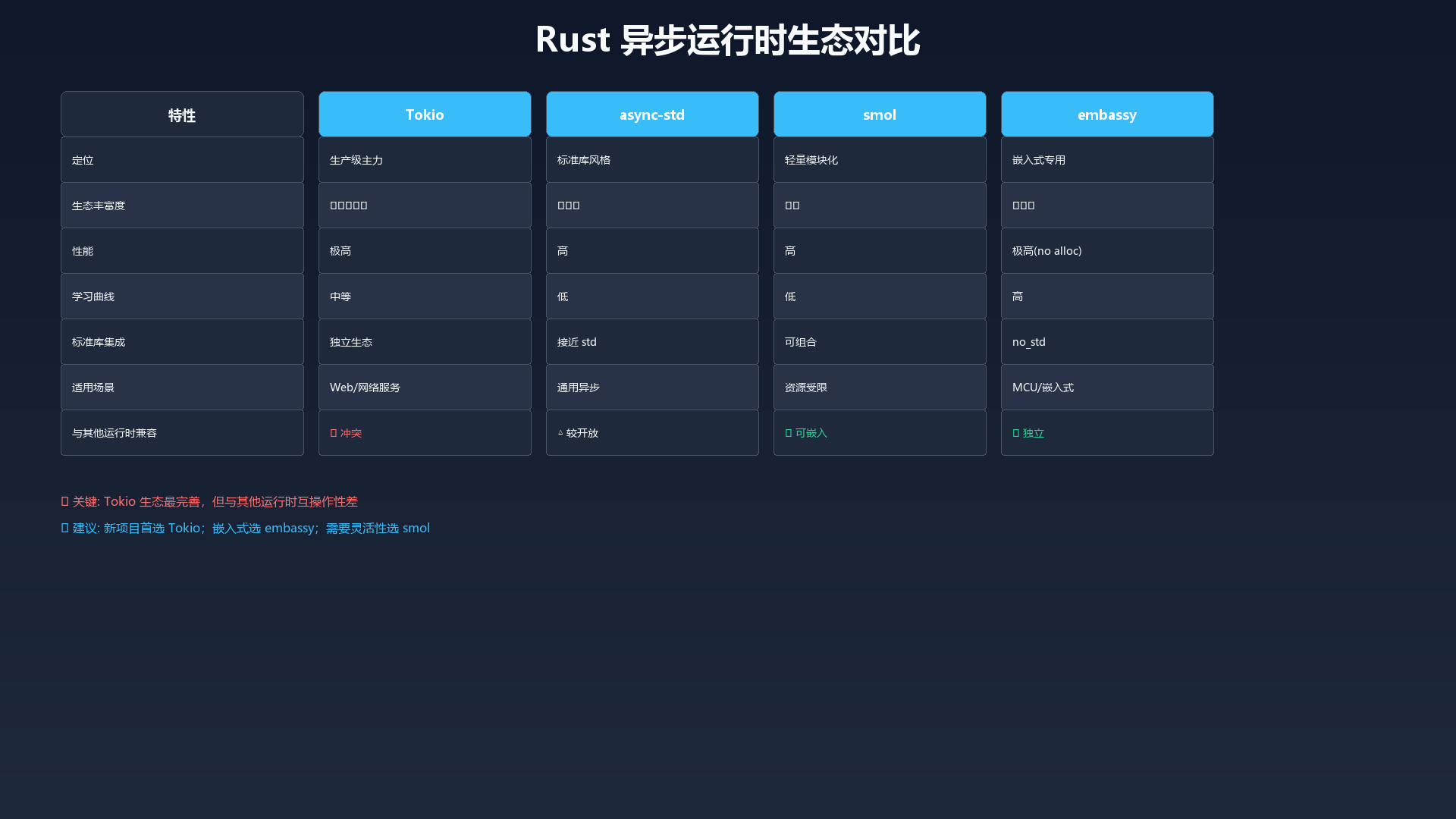
From the diagram above, you can clearly see the positioning and differences of each runtime. Tokio has the most complete ecosystem but poor interoperability with other runtimes — this is the fundamental reason why many developers are forced to “choose a side.”
Real-life Analogy: Phone Charging Cables
This is like the battle over phone charging port standards. You bought a bunch of Type-C accessories, only to find one day that a certain device only supports Lightning. You clearly have a high-quality cable in hand, but you just can’t plug it in.
Tokio is that “Type-C” — it almost won, but not in a dignified way, because it won through ecosystem monopoly, not standard unification.
3. Pin and Unpin: The “Rite of Passage” for Async Rust
If you asked me to pick the concept that crashes Async Rust beginners the most, I would unhesitatingly vote for Pin.
You just wanted to write a simple async function, store a Future, or pass it into some closure. Then the compiler tells you:
error[E0277]: `std::future::from_generator::GenFuture<[static generator@main.rs:10:5: 15:6]>` cannot be unpinned
You go to the documentation with a blank face and discover that Pin exists to solve the “self-referential struct” problem. What’s a self-referential struct? It’s a struct where one field points to another field within the same struct. Such a struct can’t be casually moved in memory, because after moving, the pointer becomes dangling.
And Rust’s async state machine is precisely a self-referential struct. Because in the state machine generated by the compiler, certain states might hold references pointing to other states. So you must use Pin to “nail” it in memory, ensuring it won’t be secretly moved.
Sounds reasonable, right? But the problem is, this complexity is exposed to the user.
You write Vec<Box<dyn Future<Output = ()>>> wanting to store a bunch of async tasks, only to find it doesn’t work — you have to change it to Vec<Pin<Box<dyn Future<Output = ()>>>>. You write a function wanting to return a Future, only to find you need to add Pin to the return type too. You just wanted to write a simple async program, but were forced to learn about memory layout, self-referential structs, and Pin::new_unchecked — that unsafe operation that makes your palms sweat.
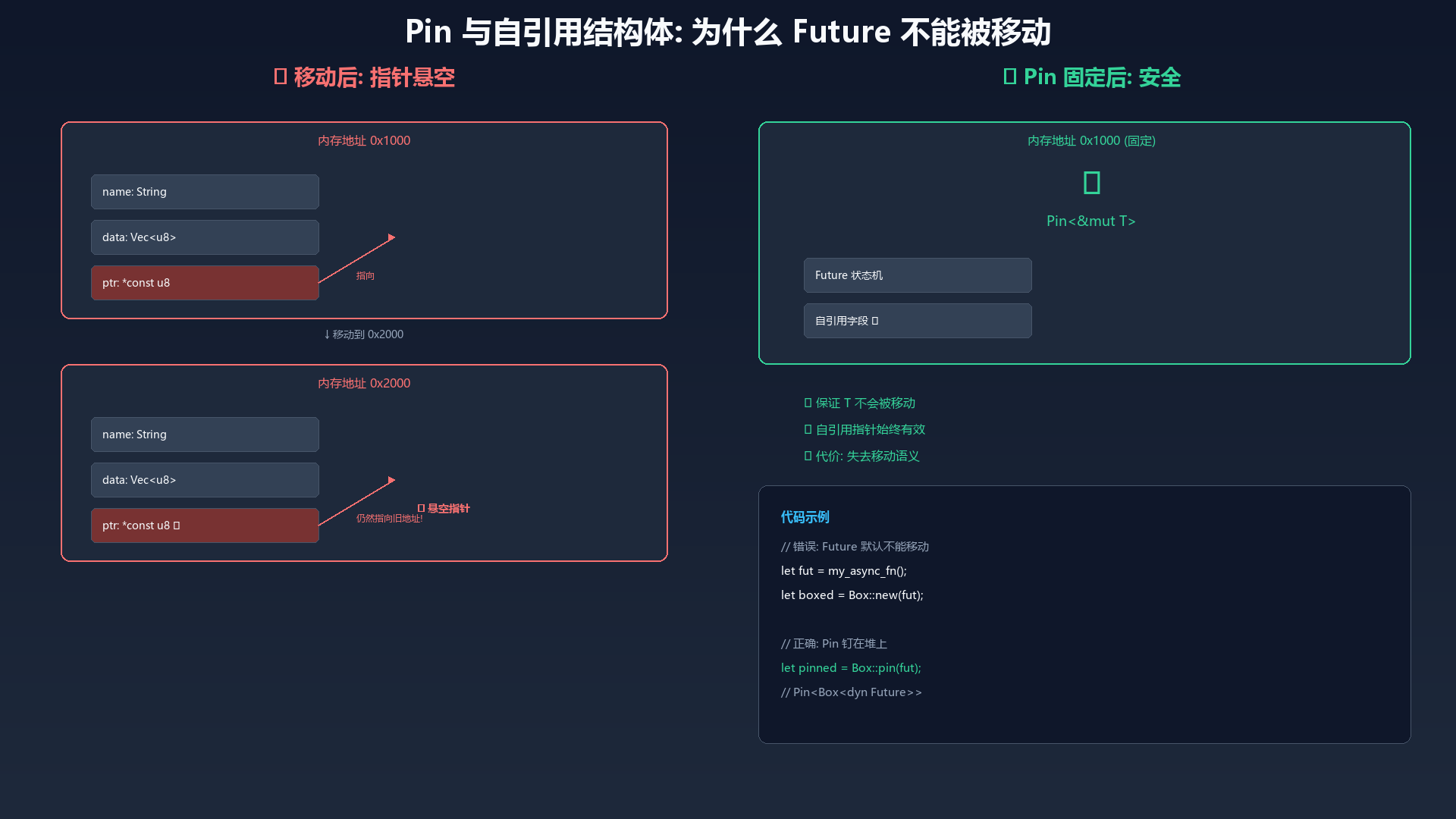
The diagram above shows why self-referential structs can’t be moved, and how Pin guarantees pointer safety by prohibiting movement. The left side shows the dangling pointer problem after moving, while the right side shows the safe model after Pin fixation.
Real-life Analogy: Moving vs. a Bookshelf Nailed to the Wall
Imagine you have a bookshelf with books leaning against each other (self-referential). If you move the entire bookshelf to another room, those leaning books will fall. Pin is like nailing the bookshelf to the wall with expansion screws — you can read books, swap books, but you can’t move the entire bookshelf.
The question is, I just wanted to borrow a book to read. Why do I need to learn how to install expansion screws first?
4. Cancellation Safety: Your Task Can “Suddenly Die” at Any Moment
In most async ecosystems, cancelling a task is considered safe. You don’t want to wait anymore, just abort it, and the runtime cleans up the mess for you.
Rust doesn’t think so.
In Async Rust, a Future can be directly dropped. This means your async task can be abruptly cut off at any .await point, like a person crossing the road when the traffic light suddenly turns red, but they’re already in the middle of the road.
If at this moment your code is performing some critical operation — like writing half the data to a database, or releasing a lock — directly dropping it will lead to resource leaks, data inconsistency, or even more serious logical errors.
What’s even more troublesome is that Rust doesn’t have async Drop. If your cleanup logic itself needs to await (like asynchronously closing a network connection), you can’t directly write .await in Drop. You have to resort to various workarounds, like spawning a cleanup task with tokio::spawn, or using experimental crates like async_drop.
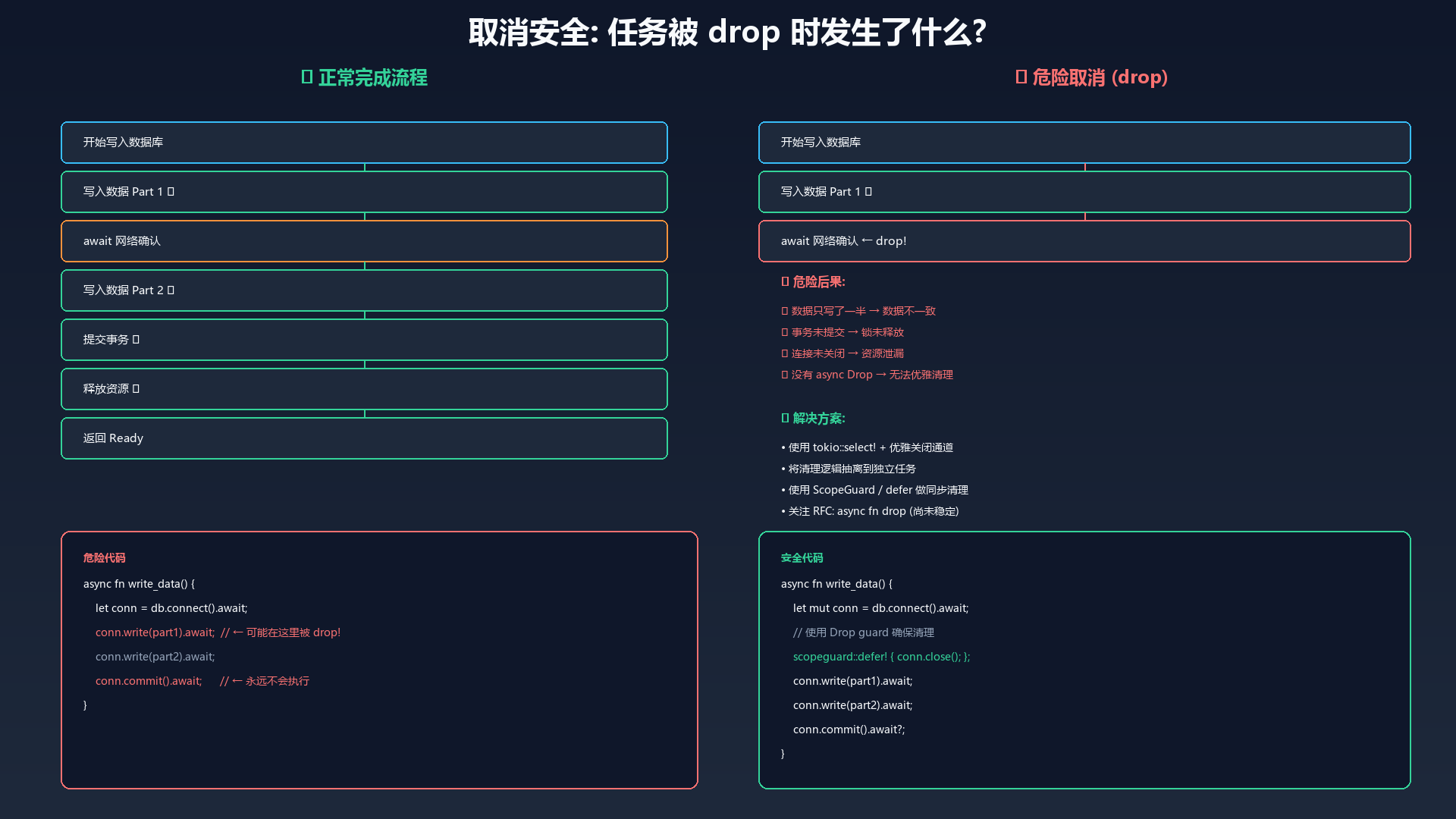
The diagram above compares the differences between normal completion and mid-way cancellation (drop). In the normal flow, all resources are properly released, while dangerous cancellation may lead to problems like half-written data, uncommitted transactions, and unreleased locks.
Real-life Analogy: Surgery in the Emergency Room
Imagine you’re having surgery when the anesthesiologist suddenly says “I’m off duty” and pulls out all the tubes. That’s cancellation in Async Rust. No graceful cleanup, no “please wait while I stitch up the wound” — just sudden darkness.
5. Performance Is the Selling Point, But Also the Trap
Many people choose Async Rust for performance. That’s true — Async Rust can achieve very low latency and very high throughput. But the problem is — performance isn’t free, and it’s easily destroyed by your own hands.
The most common pitfall is mixing blocking operations in async code. For example:
async fn handle_request() {
    let data = std::fs::read("big_file.txt").unwrap(); // Blocking!
    process(data).await;
}
Looks harmless, right? But std::fs::read is blocking. When you execute this operation on a Tokio worker thread, the entire thread gets stuck, and all other tasks queued on this thread have to wait. If your concurrency is even slightly high, the entire runtime will be dragged down by a few blocking operations.
Similar traps include:
- Using
std::sync::Mutexinstead oftokio::sync::Mutexin async code - Doing large amounts of CPU-intensive calculations without yielding
- Indiscriminately
Box::pinning every Future, causing pointer jump overhead to explode
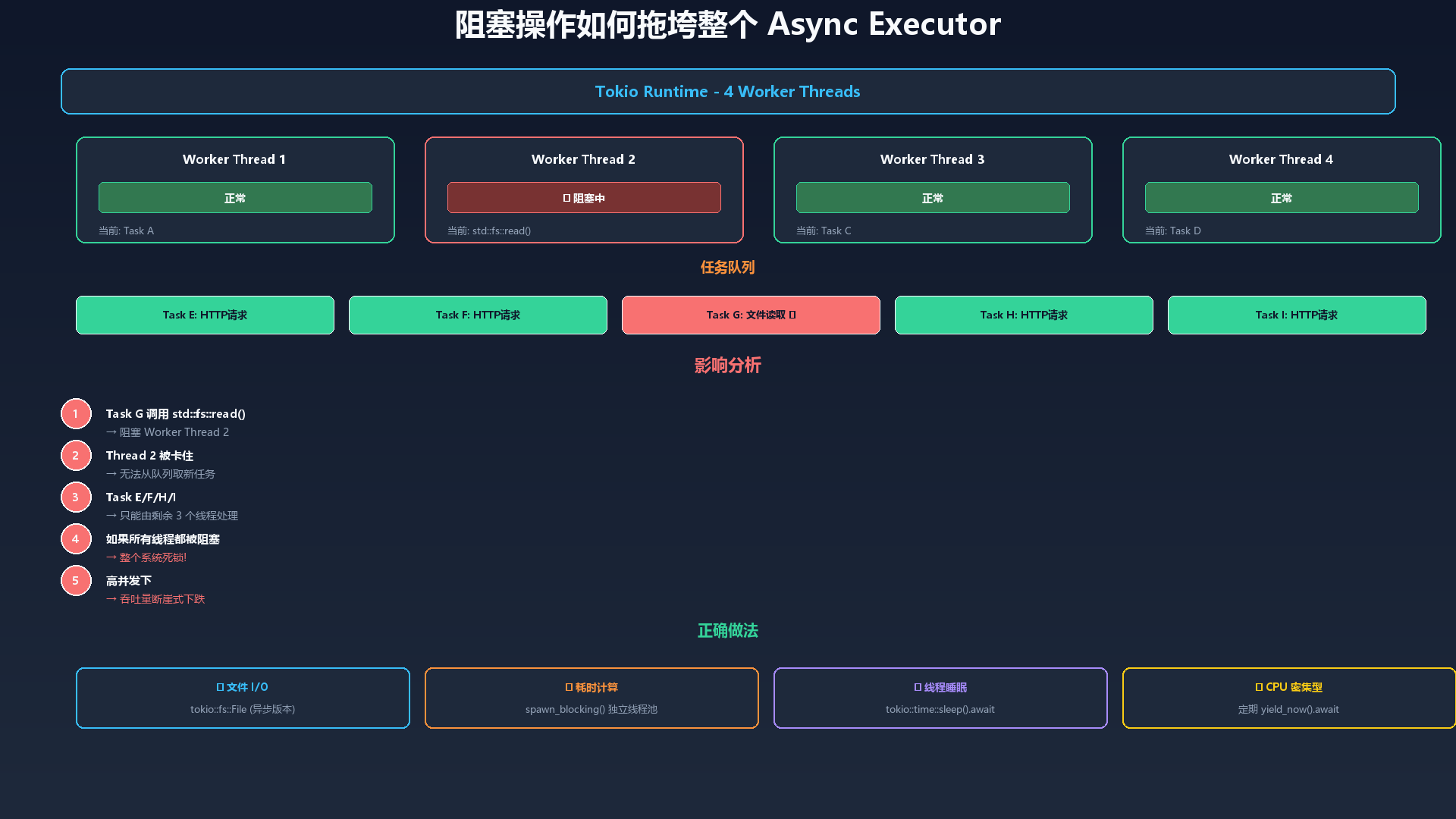
The diagram above shows the devastating impact of blocking operations on the entire Executor. When a task calls std::fs::read(), the corresponding Worker Thread is completely stuck, and other tasks can only be handled by the remaining threads. If all threads are blocked, the entire system falls into deadlock.
Async Rust gives you extreme performance potential, but also requires you to have a clear understanding of the runtime’s scheduling mechanism, thread model, and what your own code is doing.
Real-life Analogy: Delivering Food in a Lamborghini
You bought a Lamborghini to deliver food. In theory, the speed is unmatched. But if you turn off the engine and restart it at every red light, or pile 500 pounds of bricks in the back seat, it won’t run faster than an electric tricycle.
6. Async Trait: Seemingly Simple Abstraction, But Feels Like Advanced Math
Rust 1.75 finally stabilized async fn in trait, which was supposed to be great news. But when you actually start writing, you find things aren’t that simple.
The combination of dynamic dispatch (dyn Trait) and async functions is still a pain point. You want to write a trait method that returns impl Future, or use Box::pin for dynamic dispatch — you’ll encounter various lifetime and Send/Sync constraint issues.
Error handling too. In synchronous code, the propagation path of a Result is very clear. But in async systems, errors may emerge from multiple concurrent tasks, multiple layers, at different points in time. If you haven’t designed a good error propagation and observation mechanism, debugging is like looking for a specific thread in a tangled mess.
Real-life Analogy: Lego Bricks vs. 3D Puzzles
Synchronous Rust traits are like Lego bricks — standard interfaces, just snap them together. Async traits are like 3D puzzles — they look similar, but each piece has special bumps and indentations. If you put them together wrong, they get stuck, and the instruction manual is missing a few pages.
7. So, Is Async Rust Still Worth Learning?
Yes, but only if you know what contract you’re signing.
Async Rust isn’t the kind of technology that “you learn and immediately become more productive.” It’s a trade-off — exchanging higher cognitive burden for lower latency, finer-grained control, and more deterministic resource usage.
If your scenario is:
- High-concurrency network services (like gateways, proxies, game servers)
- Systems extremely sensitive to latency
- Resource-constrained embedded environments
Then Async Rust is almost the best choice. Its performance ceiling is indeed high, and once you’ve figured out those pitfalls, the code you write is both stable and fast.
But if your scenario is:
- An ordinary CRUD web backend
- Internal tools or scripts
- A team where most people don’t have Rust experience
Then forcing Async Rust might just be asking for trouble. Go, or even traditional thread pool models, might be more pragmatic choices.
Final Thoughts
The power of Async Rust lies not in hiding complexity, but in laying that complexity out in front of you and giving you the opportunity to control it.
This is its charm, and its curse.
It’s not for people who want to “get it done quickly.” It’s for those willing to spend time understanding the底层, willing to wrestle with the compiler, and who truly need that little bit of extra performance and control.
So, if you’re currently being tortured by Pin, Unpin, and a pile of red compiler errors, don’t lose heart. You’re not stupid — you’re just experiencing the “rite of passage” that every Async Rust developer goes through.
Get through it, and you’ll find that you’ve not only learned to write async code, but also reviewed operating systems, memory management, and concurrency scheduling along the way.
That’s a deal worth making.
Want to learn more about Rust async in practice? Follow the “DreamBeast Programming” WeChat official account for weekly hardcore tutorials covering底层principles to production pitfalls.
Also check out the DreamBeast Programming AI Coding Assistant Service to help you use AI coding tools in production environments.
