Rust Compiler Error 'cannot borrow as mutable'? Think of s.clear() as 'Tearing a Book'

The most hair-pulling moment in Rust coding is probably when you feel your logic is flawless, but the compiler throws a long string of red error text: cannot borrow as mutable because it is also borrowed as immutable.
You just wanted to use s.clear() to empty a string. Who did you offend? At this moment, Rust acts like a strict librarian, refusing to let you touch anything.
But this isn’t personal. Let’s switch perspectives and use the example of “Can you tear up a book while reading it?” to see what this error is actually protecting.
The Crime Scene
Suppose you want to find the first word of a string, and then clear the string to save memory. The code looks something like this:
fn main() {
    let mut s = String::from("hello world");

    // 1. Borrow an immutable reference (word is a slice of s)
    let word = first_word(&s);

    // 2. Attempt to clear the string (requires mutable borrow)
    s.clear(); // ❌ Error!

    // 3. Use that immutable reference again
    println!("the first word is: {}", word);
}

fn first_word(s: &String) -> &str {
    // ... implementation omitted, returns a slice of s
    &s[0..5]
}
The compiler immediately jumps out to warn you:
cannot borrow 's' as mutable because it is also borrowed as immutable
You might grumble: “I’m just clearing s, what does that have to do with word?”
No Tearing Books in the Library
Imagine s is a rare book in a library.
Immutable Borrow (
&s): This is reading in the library. The library allows multiple people to read at the same time (multiple people holding immutable references). Everyone gathers around the table to read, no problem. At this time,wordis the note you copied on your hand (e.g., page 1 to page 5 of this book).Mutable Borrow (
&mut s): This is whats.clear()wants to do—modify the content, or even tear the book into blank paper.
Why the Conflict?
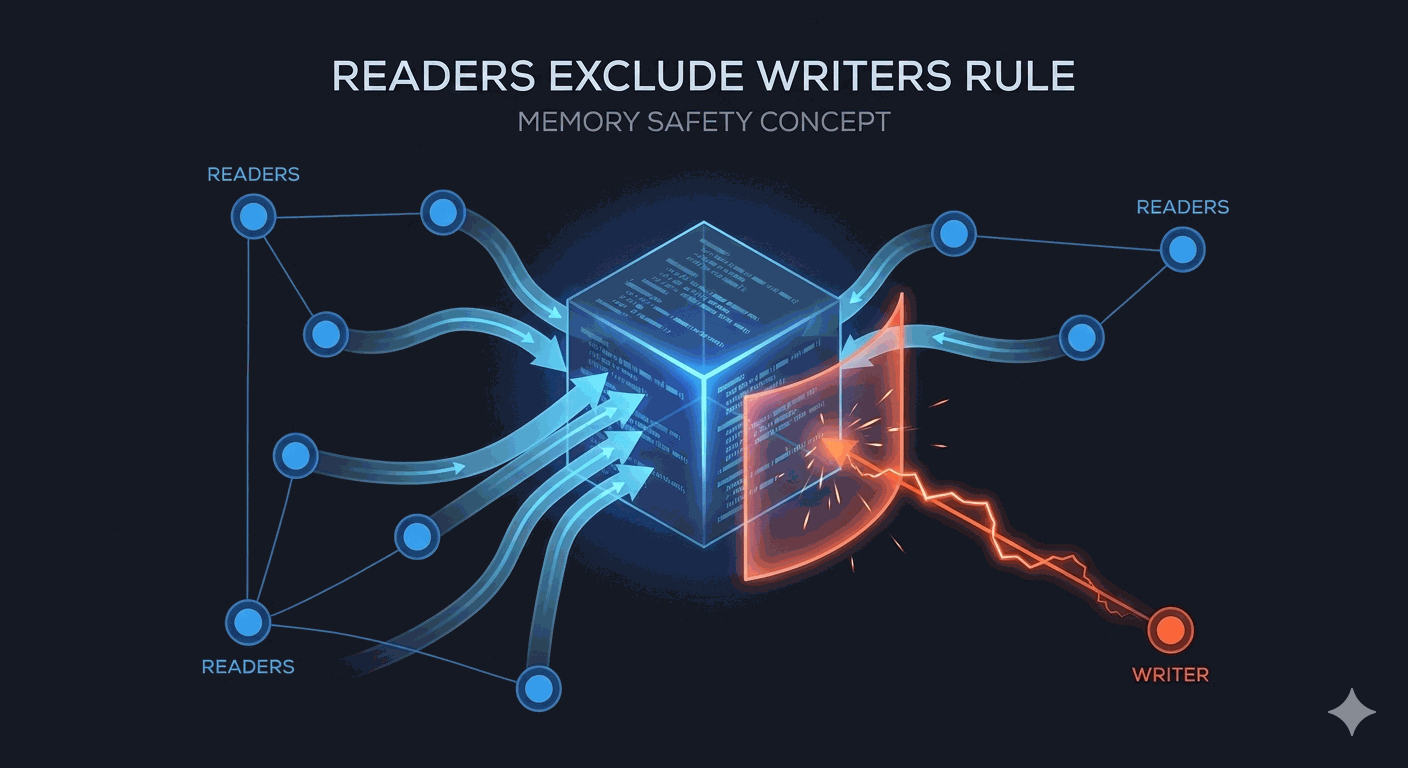
Imagine you are reading your note (word) with gusto, and suddenly someone rushes over to tear up the book (s.clear()).
If he actually tears it up, the note in your hand points not to book pages, but to thin air. If you try to read it again (println!), the program will either crash or read garbage data.
Rust’s Iron Rule is simple:
When someone is reading, no one can write. (Readers exclude Writers)
How to Solve It?
Since it’s a “read-write conflict,” there are two solutions: either finish reading before modifying, or separate them completely.
1. Finish Reading Before Modifying (Scope Adjustment)
This is the simplest way. Since word is still needed (in println!), wait until you are done with it. Just ensure s.clear() happens after word has left the stage.
fn main() {
    let mut s = String::from("hello world");

    // Scope starts: word borrows s
    let word = first_word(&s);

    // Use word here. After this, Rust's NLL (Non-Lexical Lifetimes) mechanism
    // will determine that word's lifetime has ended
    println!("the first word is: {}", word);

    // Now s has no borrows on it, feel free to modify
    s.clear(); // ✅ Compiles!
}
Analogy: You finish reading the book, finish your notes, and leave. Then the librarian comes to tear up the book (cleanup). No one is affected.
2. Make a Copy (Clone)
If you absolutely must use that word after s.clear(), then don’t borrow the book—photocopy it and take it with you.
fn main() {
    let mut s = String::from("hello world");

    // Don't borrow a reference to s, convert the slice to a brand new String
    let word = first_word(&s).to_string();

    s.clear(); // s is cleared

    // word is your own photocopy, unrelated to s now, use it however you want
    println!("the first word is: {}", word); // ✅ Compiles!
}

Cost: to_string() or clone() involves copying data, which costs a bit more memory (buying a book is more expensive than borrowing), but these two variables are now completely decoupled.
Common Pitfalls
Implicit Borrowing
Sometimes you don’t write &, but some methods borrow secretly.
let len = s.len(); // len() reads, short immutable borrow, ends instantly
s.clear(); // No problem
Debug Printing
A common mistake for beginners: trying to debug variables, accidentally extending their lifetime.
let word = first_word(&s);
s.clear();
// This line was originally for debugging, but it caused the error above
// Delete this line, or move it before clear, and the code runs
dbg!(word);
Summary
Remember this mantra, and Rust borrowing won’t be hard:
Shared is Immutable, Mutable is not Shared. If you want to tear the book, wait for the readers to leave.
Lifesaver Cheatsheet
Encountering cannot borrow as mutable?
- Check Borrows: Who borrowed
&sbefore this line? - Check End: Where was that borrow (e.g.,
word) last used? - Move: Can you move the modification (
s.clear()) after the last usage? - Ultimate Move: If all else fails, just
.clone().
Find this article helpful?
- Like: If the “tearing book” analogy clicked for you, give it a like!
- Share: Send this to your friends who are fighting with the Rust compiler.
- Follow: Follow RexAI for more tech solutions explained with daily life examples.
- Comment: What other Rust errors drive you crazy? Let me know in the comments!
Your support is my biggest motivation to keep creating!