Stop Panicking on Failure: Production‑Ready ink! Events & Error Handling
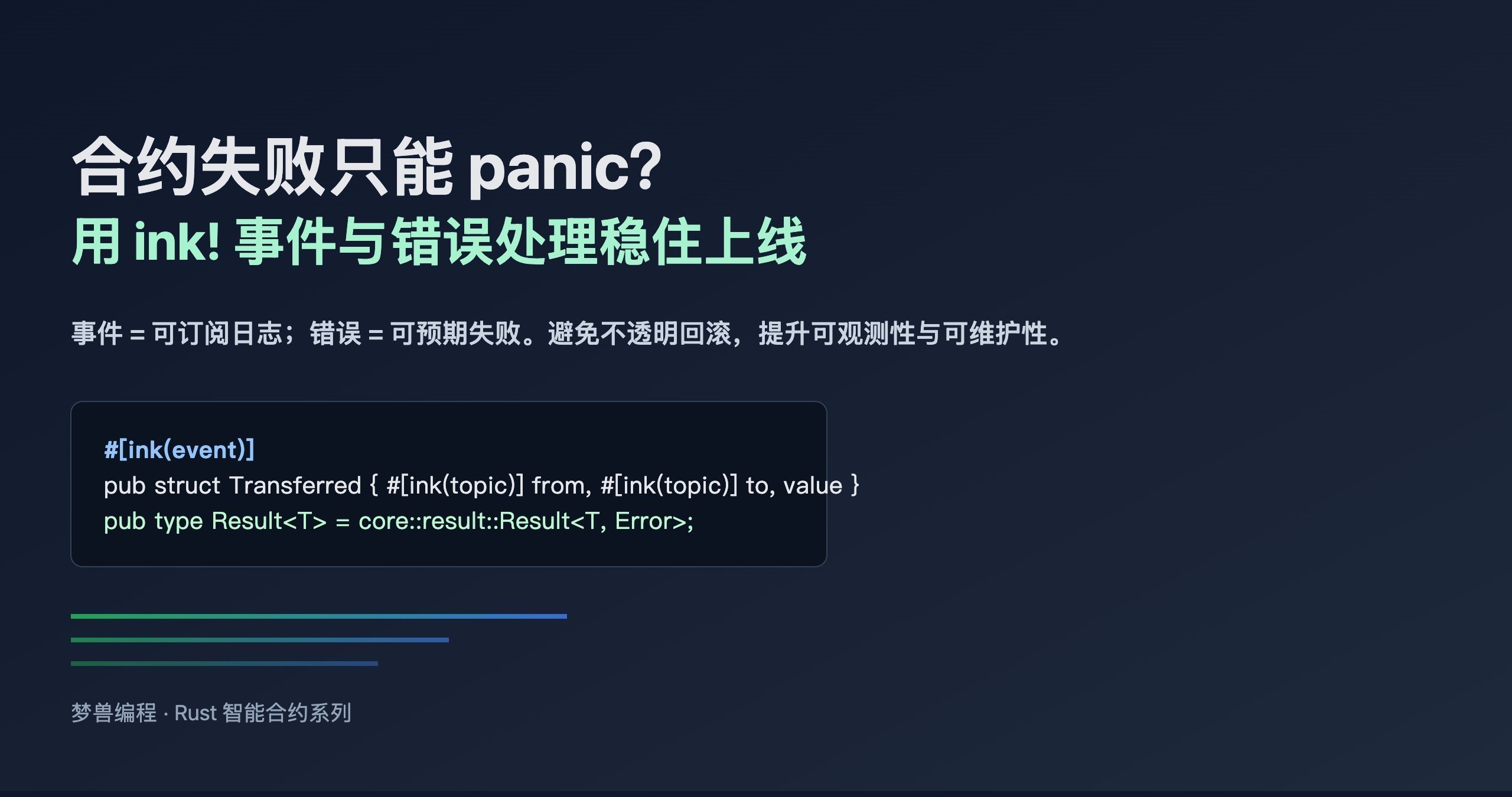
Table of Contents
Three quick questions: what are we fixing today?
- Still guessing what happened on‑chain by grepping logs?
- Does your contract just
panic!and roll back, leaving the UI with a generic error? - Want clean, typed failures so the frontend can show precise messages?
The answers: let contracts “speak” via Events, catch failures via typed Results, and land both with a minimal, runnable example.
Tip: If you haven’t run a minimal ink! contract yet, start with our counter walkthrough, then come back:
- Rust Smart Contract Onboarding: Ship the ink! Counter → /tutorials/smart-contracts/rust-smart-contract-ink-counter/
What are Events (and why they matter)?
Think of events as “searchable on‑chain logs”. Whenever state changes, emit a structured message:
- Frontends (listeners) update UI (balances, NFT transfers…)
- Indexers filter/aggregate reliably
- Auditors can replay behavior on/off‑chain
Declare events with a struct + attribute macro:
#[ink(event)]
pub struct Transferred {
    #[ink(topic)]
    from: Option<AccountId>,
    #[ink(topic)]
    to: Option<AccountId>,
    value: Balance,
}
Notes:
#[ink(event)]marks an event type.#[ink(topic)]indexes a field for filtering (addresses, IDs…). Non‑topic fields are still recorded but not indexed.
Emit an event where the change happens:
self.env().emit_event(Transferred {
    from: Some(from),
    to: Some(to),
    value,
});
Thumb rule: any user‑visible state change (mint, transfer, approve, config change) should emit an event.
Error handling the right way
Prefer returning Result<T, E> from #[ink(message)] functions with a custom error enum. It’s predictable, testable, and friendly to UIs.
#[derive(scale::Encode, scale::Decode, Debug, PartialEq, Eq)]
#[cfg_attr(feature = "std", derive(scale_info::TypeInfo))]
pub enum Error {
    NotOwner,
    InsufficientBalance,
}

pub type Result<T> = core::result::Result<T, Error>;
Avoid panic! in contract logic:
- Panics cause trap rollbacks — opaque and harder to diagnose.
- Typed errors let the frontend map cases to clear messages.
Minimal example: tiny token with events and errors
This micro‑contract demonstrates two things:
- Transfers emit a
Transferredevent with indexed topics. - Insufficient balance / wrong permission return typed errors instead of panics.
#![cfg_attr(not(feature = "std"), no_std)]

#[ink::contract]
mod mini_token {
    use ink::storage::Mapping;

    #[ink(storage)]
    pub struct MiniToken {
        owner: AccountId,
        total_supply: Balance,
        balances: Mapping<AccountId, Balance>,
    }

    #[derive(scale::Encode, scale::Decode, Debug, PartialEq, Eq)]
    #[cfg_attr(feature = "std", derive(scale_info::TypeInfo))]
    pub enum Error {
        NotOwner,
        InsufficientBalance,
    }

    pub type Result<T> = core::result::Result<T, Error>;

    #[ink(event)]
    pub struct Transferred {
        #[ink(topic)]
        from: Option<AccountId>,
        #[ink(topic)]
        to: Option<AccountId>,
        value: Balance,
    }

    impl MiniToken {
        #[ink(constructor)]
        pub fn new() -> Self {
            Self {
                owner: Self::env().caller(),
                total_supply: 0,
                balances: Mapping::default(),
            }
        }

        #[ink(message)]
        pub fn mint(&mut self, to: AccountId, value: Balance) -> Result<()> {
            let caller = self.env().caller();
            if caller != self.owner {
                return Err(Error::NotOwner);
            }
            let to_balance = self.balances.get(&to).unwrap_or(0);
            self.balances.insert(to, &(to_balance.saturating_add(value)));
            self.total_supply = self.total_supply.saturating_add(value);
            self.env().emit_event(Transferred {
                from: None,
                to: Some(to),
                value,
            });
            Ok(())
        }

        #[ink(message)]
        pub fn transfer(&mut self, to: AccountId, value: Balance) -> Result<()> {
            let from = self.env().caller();
            let from_balance = self.balances.get(&from).unwrap_or(0);
            if from_balance < value {
                return Err(Error::InsufficientBalance);
            }
            let to_balance = self.balances.get(&to).unwrap_or(0);
            self.balances.insert(from, &(from_balance - value));
            self.balances.insert(to, &(to_balance + value));
            self.env().emit_event(Transferred {
                from: Some(from),
                to: Some(to),
                value,
            });
            Ok(())
        }

        #[ink(message)]
        pub fn balance_of(&self, who: AccountId) -> Balance {
            self.balances.get(&who).unwrap_or(0)
        }
    }

    #[cfg(test)]
    mod tests {
        use super::*;
        use ink::env::test;

        #[ink::test]
        fn mint_emits_event() {
            let mut token = MiniToken::new();
            let bob = ink::env::test::default_accounts::<ink::env::DefaultEnvironment>().bob;
            assert!(token.mint(bob, 100).is_ok());
            let events: Vec<_> = test::recorded_events().collect();
            assert_eq!(events.len(), 1); // there is an event recorded
        }

        #[ink::test]
        fn transfer_checks_balance() {
            let mut token = MiniToken::new();
            let accounts = test::default_accounts::<ink::env::DefaultEnvironment>();
            assert!(token.mint(accounts.bob, 100).is_ok());

            test::set_caller::<ink::env::DefaultEnvironment>(accounts.bob);
            assert!(matches!(token.transfer(accounts.alice, 150), Err(Error::InsufficientBalance)));
            assert!(token.transfer(accounts.alice, 40).is_ok());
            assert_eq!(token.balance_of(accounts.alice), 40);
        }
    }
}
Build & test (see our ink! setup in the counter article):
cargo contract build --release
cargo test
Production checklist: observability + recoverability
- Emit events on any user‑visible state change (transfer, approve, config).
- Use
Result<T, Error>for UI‑relevant branches; make errors precise. - Only
#[ink(topic)]fields you need to filter on (addresses/IDs). - Unit‑test error paths and event counts; decode fields if necessary.
- Avoid
panic!; prefersaturating_*to sidestep arithmetic overflow. - Keep event names stable and clear (
Transferred,Minted,Approved).
Common pitfalls
- No topics on events → hard to filter; high indexing cost.
- Panicking inside messages → opaque rollbacks; return typed errors instead.
- One catch‑all error → split into precise enums (permission, balance, not‑found…).
- Tests only cover happy paths → add failure + event assertions.
FAQ
- Do events require topics? No, but add topics for key filter dimensions (addresses/IDs).
- Do
panic!s roll back? Yes, but they’re opaque. PreferResultwith typed errors. - How to assert event content? Use
ink::env::test::recorded_events(); decode as needed.
Wrap‑up & next steps
You can now make contracts “speak” (events) and “refuse clearly” (typed errors). Try:
- Add an
Incrementedevent and an upper‑bound error to the counter. - Add
Approved/Approvalflow plus events to this token. - Wire an E2E script to listen for events and drive UI state.
Engage & support
- Like, bookmark, and share if this helped your team.
- Follow “Rexai Programming” for upcoming Rust smart contract guides.
- Drop a comment with blockers; I’ll add examples or corrections.
References & further reading
- ink! official site (The ink! Book): https://use.ink/
- cargo‑contract tool: https://github.com/paritytech/cargo-contract
- Substrate Contracts (FRAME pallets): https://docs.substrate.io/reference/frame-pallets/
- SCALE codec: https://docs.substrate.io/reference/scale-codec/
- Polkadot.js (API / Apps for event watching): https://polkadot.js.org/
- Subsquid (indexer docs): https://docs.subsquid.io/
- Part 1 (counter walkthrough): /en/tutorials/smart-contracts/rust-smart-contract-ink-counter/
- Part 5 (access control patterns): /en/tutorials/smart-contracts/rust-smart-contract-access-control/